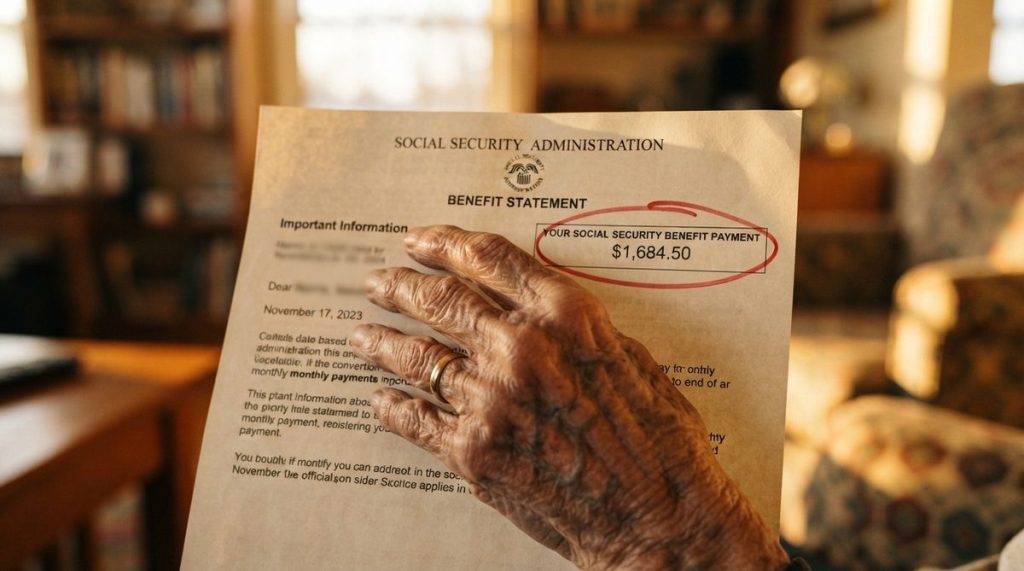


Margaret’s Story: A Raise That Wasn’t Really a Raise
Last January, Margaret Delgado of Tampa, Florida, opened her Social Security statement expecting good news. The 2026 cost-of-living adjustment had bumped her monthly benefit by 2.8%, adding roughly $58 to her check. She told me she briefly felt relieved — until she saw the other side of the ledger.
Her Medicare Part B premium had climbed by $10.30 per month. Her Part D prescription drug plan added another $7. And because the COLA pushed her combined income just above a tax threshold she’d been skirting for two years, she suddenly owed federal taxes on a larger portion of her Social Security benefits. Net gain after all deductions? About $18 a month.
“I buy one extra bag of groceries,” Margaret told me during a phone call in March. “That’s what my raise bought me.”
Now, as the Senior Citizens League projects the 2027 Social Security COLA at 3.8%, I’m hearing the same cautious optimism — and the same underlying worry — from retirees across the country. The percentage sounds generous. The reality is more complicated. And if you don’t plan ahead, the same forces that ate Margaret’s raise could consume yours too.
What the 3.8% COLA Projection Actually Means
The Social Security cost-of-living adjustment is calculated using the Consumer Price Index for Urban Wage Earners and Clerical Workers (CPI-W), specifically comparing the third-quarter average of the current year to the prior year. The Social Security Administration won’t announce the official 2027 COLA until October 2026, but the Senior Citizens League — a nonpartisan advocacy group that has tracked COLA projections for over two decades — currently estimates it at 3.8%.
For context, here’s how that stacks up against recent years. The 2023 COLA was a historic 8.7%. In 2024, it dropped to 3.2%. The 2025 adjustment was 2.5%, and 2026 came in at 2.8%. A 3.8% COLA in 2027 would actually be the second-highest adjustment in five years, trailing only the inflation-driven spike of 2023.
On paper, 3.8% applied to the average retiree benefit of approximately $1,976 per month means an increase of about $75 monthly, or $900 annually. That’s real money. But in my 15 years working in consumer finance — including my time at the CFPB analyzing how policy changes ripple through household budgets — I’ve learned that the headline number almost never tells the full story.
The Medicare Premium Bite: Your Raise’s First Predator
Every year, like clockwork, a portion of any Social Security COLA gets absorbed by rising Medicare costs. It’s a pattern so consistent that I sometimes call it “the annual clawback.”
The standard Medicare Part B premium for 2026 is $185 per month, up from $174.70 in 2025. The 2026 Medicare Trustees Report signaled that Part B costs will continue climbing due to higher spending on physician services, outpatient care, and new high-cost drugs. While the 2027 Part B premium won’t be finalized until late 2026, projections from the Congressional Budget Office suggest it could land between $190 and $198 per month.
If the premium increases by even $12 per month, that’s $144 of your $900 annual COLA gone — roughly 16% — before you spend a dime. For a deeper breakdown of this dynamic, take a look at our analysis on why Medicare premiums eat your Social Security COLA.

The IRMAA Trap Most Retirees Don’t See Coming
Here’s where it gets worse for middle-income retirees. If your modified adjusted gross income (MAGI) exceeds certain thresholds — $103,000 for individuals or $206,000 for married couples filing jointly in 2025 — you pay Income-Related Monthly Adjustment Amounts (IRMAA) on top of the standard Part B and Part D premiums.
What I see most often is retirees who don’t realize that a Roth conversion, a Required Minimum Distribution bump, or even a one-time capital gain from selling a home can push them into a higher IRMAA bracket two years later. Medicare uses your tax return from two years prior, so a financial decision you made in 2025 determines your 2027 premiums.
The IRMAA surcharges are not trivial. At the first tier above the threshold, you’d pay an additional $74.00 per month for Part B alone. At the highest tier, the surcharge exceeds $395 monthly. That’s not a nibble out of your COLA — it’s a full meal.
The Taxation Problem No One Warned You About
This is the issue that Margaret ran into, and it’s one I’ve been writing about and advocating against for years. The thresholds for taxing Social Security benefits haven’t been updated since 1993. Let that sink in: the income levels that determine whether your benefits get taxed were set over 30 years ago, when the median home price was $106,000 and a gallon of gas cost $1.11.
How Social Security Benefit Taxation Works
Under current law, if your “combined income” — which the IRS defines as your adjusted gross income plus nontaxable interest plus half your Social Security benefits — exceeds $25,000 as an individual or $32,000 as a married couple, up to 50% of your Social Security benefits become taxable. If your combined income exceeds $34,000 (individual) or $44,000 (couple), up to 85% of your benefits can be taxed.
Because these thresholds have never been indexed to inflation, every single COLA gradually pushes more retirees above them. In 1984, when benefit taxation was introduced, only about 10% of Social Security recipients owed taxes on their benefits. Today, according to the Social Security Administration’s own data, that figure has climbed to roughly 56%.
The 2027 COLA of 3.8% will push even more retirees into taxable territory. If you’re currently sitting just below the $25,000 or $34,000 threshold, an extra $75 per month in Social Security income could be the factor that triggers taxation on thousands of dollars of benefits you weren’t paying taxes on before.
New Legislative Proposals: Hope on the Horizon?
There’s been renewed Congressional attention to this problem. Representatives John Larson and Senator Richard Blumenthal have introduced the Social Security 2100 Act, which among other provisions would begin adjusting these tax thresholds. Additionally, there are new proposals specifically targeting Social Security benefit taxation reform, including ideas to raise the combined income thresholds to $50,000/$100,000 or eliminate benefit taxation for households below certain levels entirely.
I’m cautiously optimistic, but I also tell my readers this: do not plan your retirement finances around legislation that hasn’t passed. Plan for the rules as they exist today, and treat any reform as a bonus if and when it happens.
Inflation’s Quiet Erosion: The Real Enemy
Even if the COLA perfectly matched inflation — which it historically doesn’t, because the CPI-W doesn’t capture senior-specific spending patterns — the compounding effect of years of purchasing power loss has taken a serious toll.
A 2026 survey by the Employee Benefit Research Institute found that 40% of retirees reported spending down their savings faster than they’d planned, with inflation being the primary reason. Medical costs, food, utilities, and property insurance — categories where seniors spend disproportionately more — have all risen faster than the general CPI over the past three years.
This is what some financial planners call “the silent killer for retirement portfolios.” It’s not a market crash. It’s not a scam. It’s the slow, grinding reality that $1,000 in 2020 buys you roughly $820 worth of goods in 2026. If your retirement income isn’t growing faster than that erosion, you’re falling behind even when your check gets bigger. For more on this dynamic, I recommend our detailed guide on the retirement savings depletion crisis and why seniors run out of money faster.

Seven Steps to Actually Keep Your 2027 COLA
Here’s the part where I shift from diagnosing the problem to giving you a concrete action plan. These are strategies I’ve recommended to thousands of readers and that I’ve seen work in practice. Start now — don’t wait until January 2027.
- Calculate your combined income before the COLA hits. Pull your most recent tax return and add up your AGI, nontaxable interest, and half your current Social Security benefit. Then add the projected COLA increase. If you cross a taxation threshold, you have time to adjust.
- Consider a strategic Roth conversion this year. If you have traditional IRA or 401(k) funds, converting a portion to a Roth IRA in a year when your income is lower can reduce future RMDs and keep you below IRMAA and taxation thresholds. Yes, you’ll pay taxes now — but you may save significantly more in 2027 and beyond. Consult a CPA or tax advisor for the right conversion amount.
- Review your Medicare plan during Open Enrollment (October 15 – December 7, 2026). Don’t auto-renew without comparing plans on Medicare.gov. Drug formularies change annually, and a plan that was cheapest in 2026 may not be in 2027. I’ve seen retirees save $800 to $2,400 a year just by switching Part D plans.
- Check your IRMAA bracket and file an appeal if your income has dropped. If you’ve experienced a life-changing event — retirement, death of a spouse, divorce, loss of pension — you can file SSA Form SSA-44 to request that Medicare use your current-year income instead of your income from two years ago. This can save hundreds per month.
- Build a dedicated inflation buffer in your portfolio. I recommend retirees hold at least 6 to 12 months of expenses in Treasury Inflation-Protected Securities (TIPS) or I Bonds. As of mid-2026, I Bonds are still offering competitive composite rates, and TIPS provide a hedge that traditional bonds don’t. Our guide on protecting retirement savings from inflation breaks this down further.
- Audit your fixed expenses ruthlessly. Call every insurance company, utility provider, and subscription service you pay monthly. Ask for senior discounts, loyalty rates, or lower-tier plans. In my experience, the average retiree household can recover $150 to $300 per month through these calls alone.
- Don’t ignore state-level tax benefits. Thirty-eight states either fully exempt Social Security from state income tax or don’t have an income tax at all. If you live in one of the 12 states that still tax benefits — including Colorado, Connecticut, Minnesota, Montana, New Mexico, Rhode Island, Utah, Vermont, and West Virginia — investigate whether your income qualifies for a partial or full exemption under recent state-level reforms. Several of these states have raised their exemption thresholds in 2025 and 2026.
What Margaret Did Differently This Year
After our conversation in March, Margaret took three of the steps above. She switched her Part D plan during a Special Enrollment Period she qualified for after her old plan’s formulary dropped one of her medications. She worked with a volunteer tax preparer through the VITA program to calculate whether a small Roth conversion would keep her below the 85% taxation threshold in 2027. And she called her auto and homeowner’s insurance companies, bundled her policies, and saved $94 per month.
“I’m not wealthy,” she told me in a follow-up call. “But I’m not helpless, either. I just needed someone to explain what was actually happening to my money.”
That’s the core of what I want every reader to take away from this article. The 2027 Social Security COLA of 3.8% is meaningful — but only if you actively protect it from the forces designed to erode it. Medicare premiums, outdated tax thresholds, and persistent inflation aren’t going away on their own. Your job is to understand the system well enough to keep as much of your raise as possible.
Looking Ahead: What to Watch in Late 2026
The official 2027 COLA announcement will come in October 2026, based on CPI-W data from July, August, and September. Here’s what to keep your eye on between now and then.
Key Dates and Decisions
The Medicare Part B premium announcement typically follows in November. If you’re enrolled in a Medicare Advantage or Part D plan, Open Enrollment runs from October 15 through December 7, 2026 — and that window is your single best opportunity to reduce healthcare costs for the following year.
On the legislative front, watch for movement on the Larson-Blumenthal Social Security 2100 Act and any standalone bills addressing benefit taxation. Even if comprehensive reform stalls, there’s bipartisan support for adjusting the taxation thresholds, and a targeted fix could move through Congress faster than a full overhaul.
The Bigger Picture for Retirement Security
I often remind readers that Social Security was never designed to be your sole retirement income — it was intended to replace roughly 40% of pre-retirement earnings for average workers. Yet for about 40% of seniors aged 65 and older, it represents at least half of their total income, and for 14%, it’s virtually everything.
If you’re in that group, every percentage point of COLA matters enormously. And if you’re among the growing number of retirees depleting savings ahead of schedule, the strategies above aren’t optional — they’re essential.
The system isn’t going to simplify itself. But with the right information and a few proactive moves, you can make sure that when the 2027 COLA arrives, more of that 3.8% actually stays in your pocket — where it belongs.
About Sarah Mitchell, Former CFPB Senior Analyst
Sarah Mitchell is a consumer finance expert with 15 years of experience protecting American consumers. She spent eight years as a senior analyst at the Consumer Financial Protection Bureau (CFPB), where she investigated financial fraud targeting older adults and developed consumer education programs. At Daily Trends Now, Sarah covers scam awareness, smart shopping strategies, discount programs, and consumer rights — helping seniors protect their wallets and avoid costly traps.