


The Dream of Staying Home — and the Price Tag Nobody Mentions
Almost every person I’ve interviewed over my 16 years in lifestyle journalism says the same thing when I ask about their retirement plans: “I want to stay in my own home.” It’s a deeply American aspiration — the idea that the house where you raised your kids, hosted Thanksgivings, and built decades of memories should also be the place where you grow old gracefully.
And why wouldn’t you feel that way? Your home is comfort. It’s independence. It’s yours.
But here’s what I see most often: people dramatically underestimate what aging in place costs — not just financially, but emotionally, physically, and logistically. A 2024 report from the National Council on Aging found that nearly 60% of older homeowners had not budgeted for any home modifications, even as they planned to remain in their current residences indefinitely. Meanwhile, recent data from multiple housing and healthcare studies shows the average cumulative cost of aging in place can rival or even exceed assisted-living expenses in many U.S. markets.
The problem isn’t the goal. Staying home is a wonderful objective for millions of retirees. The problem is the mythology surrounding it — a collection of assumptions, half-truths, and outdated beliefs that leave people financially blindsided and physically vulnerable. Let’s dismantle seven of the most persistent myths so you can actually plan for the retirement you deserve.
Myth 1: “Aging in Place Is Always Cheaper Than Senior Living”
This is the big one, and I encounter it constantly. The logic seems airtight: you already own your home, your mortgage might be paid off, and assisted-living facilities charge $4,500 to $6,000+ per month. Staying put has to be the budget-friendly choice, right?
Not necessarily. A 2024 Genworth Cost of Care Survey pegged the national median cost of a home health aide at $33.99 per hour. If you need just four hours of daily help — assistance with meals, medication reminders, light housekeeping — that’s roughly $49,600 per year. Need eight hours? You’re looking at nearly $99,200 annually, which surpasses the median cost of an assisted-living facility in most states.
And that figure doesn’t include home modifications, property taxes, homeowner’s insurance, maintenance, utilities, or emergency repairs. When I talk to financial planners who specialize in retirement, they consistently tell me the same thing: aging in place costs are not a single line item. They’re a sprawling, evolving budget category that grows as your needs increase.
If you’re working through your retirement financial plan, understanding 8 Retiree Budget Threats in 2026 and How to Fight Back can help you see the full picture before costs spiral.
What the Research Actually Shows
A joint study by Harvard’s Joint Center for Housing Studies and AARP found that homeowners 65 and older spend a median of $8,200 per year on basic home maintenance alone — and that figure climbs steeply for homes older than 30 years. Add in modification costs (grab bars, ramps, stairlifts, widened doorways) and the first-year investment can easily hit $25,000 to $50,000 before any care services enter the equation.
The truth? Aging in place can be more affordable, but only with rigorous planning. Without it, costs quietly outpace many people’s savings.
Myth 2: “A Few Grab Bars and Better Lighting Are All You Need”
I wish it were that simple. Grab bars in the bathroom and brighter bulbs in the hallway are a good start — genuinely. But they represent maybe 5% of what a truly age-proofed home requires.
The National Institute on Aging recommends a comprehensive home safety evaluation that covers flooring transitions, stairway access, kitchen ergonomics, electrical panel accessibility, plumbing modifications, and even HVAC considerations. Falls are the leading cause of injury-related death for Americans over 65, according to the CDC, and they happen in kitchens, bedrooms, and living rooms just as often as bathrooms.
Here’s a partial list of modifications that aging-in-place specialists typically recommend:
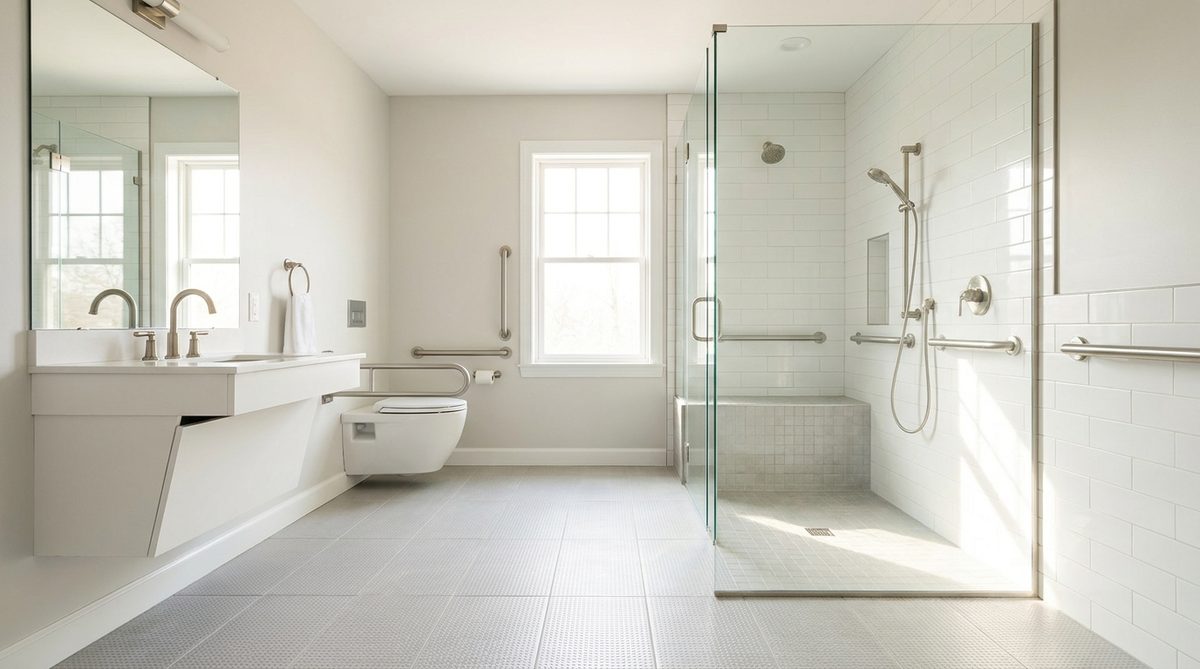
- Zero-threshold walk-in shower with built-in seating and handheld showerhead
- Lever-style door handles and faucets replacing round knobs
- Non-slip flooring throughout (not just bathrooms)
- First-floor bedroom and full bathroom if one doesn’t already exist
- Stairlift or residential elevator for multi-story homes
- Wider doorways (minimum 36 inches) for future wheelchair or walker access
- Smart home systems for lighting, temperature, and security
- Raised electrical outlets and lowered light switches
In my experience, the homeowners who fare best are the ones who make these changes before they’re urgently needed — ideally in their late 50s or 60s, when the renovations feel like upgrades rather than emergency interventions. Our detailed guide on Age-Proofing Your Home: A Real Guide to Aging in Place walks through priorities room by room.

Myth 3: “Medicare Will Cover My Home Care Needs”
This misconception has caused more financial damage to retirees than almost any other I’ve reported on. Traditional Medicare (Parts A and B) does not cover long-term custodial care at home. It covers short-term skilled nursing or home health services after a qualifying hospital stay — typically limited to 60 days of home health visits under specific conditions.
What Medicare won’t pay for:
- A home health aide who helps with bathing, dressing, or meal preparation on an ongoing basis
- Homemaker services like cleaning, laundry, or grocery shopping
- 24-hour supervision or live-in care
- Home modifications of any kind
Medicaid may cover some long-term home care, but eligibility requires meeting strict income and asset limits that disqualify most middle-class retirees. Long-term care insurance can help, but the AARP notes that only about 7.5 million Americans currently hold such policies, and premiums have risen dramatically — in some cases doubling or tripling over the past decade.
The gap between what people think Medicare covers and what it actually covers is one of the most dangerous blind spots in retirement planning. I always encourage readers to sit down with a benefits counselor or Medicare specialist well before age 65 to understand exactly where the coverage ends.
Myth 4: “My Home’s Value Will Fund Everything”
Many retirees look at their home equity — which hit record highs in many U.S. markets through 2023 and 2024 — and see a financial safety net. The thinking goes: if costs get too high, I’ll just tap my equity with a reverse mortgage or home equity line of credit.
But there are serious complications with this approach. Reverse mortgages (Home Equity Conversion Mortgages) come with origination fees, mortgage insurance premiums, and interest that compounds over time, significantly eroding the equity your heirs might inherit. More critically, the funds from a reverse mortgage may not stretch as far as you expect, especially if you’re drawing on them for 15 to 20 years of aging-in-place expenses.
The Equity Illusion
Home equity is an illiquid asset. You can’t easily spend it in small, flexible amounts the way you’d draw from a retirement account. And if the housing market softens — as it has historically done in cycles — your safety net could shrink at exactly the moment you need it most.
What I tell readers is this: treat your home’s value as one component of your aging-in-place funding strategy, not the entire strategy. Pair it with dedicated savings, long-term care insurance (if obtainable), and a realistic assessment of your projected care needs. If you’re concerned about your retirement savings runway, Retirees Depleting Savings Faster Than Expected in 2026 offers a sobering but useful reality check.
Myth 5: “I Won’t Need Help Until I’m Really Old”
This is a myth rooted in optimism, and I don’t blame anyone for believing it. But the data tells a different story. According to the U.S. Department of Health and Human Services, someone turning 65 today has nearly a 70% chance of needing some form of long-term services or support during their remaining years. And “long-term” doesn’t always mean the final chapter — it can start with something as straightforward as a knee replacement at 68 that requires six weeks of in-home help.
Chronic conditions accelerate the timeline, too. Approximately 80% of adults over 65 have at least one chronic condition, and 68% have two or more. Arthritis, diabetes, heart disease, and vision loss can all create care needs well before someone considers themselves “really old.”
In my 16 years covering this beat, I’ve watched the definition of “old” shift dramatically. People in their 70s are running marathons and launching businesses. But physical resilience and the need for home support are not mutually exclusive. You can be vibrant and active at 73 and still benefit from someone helping with yard work, heavy cleaning, or medication management.
Planning early isn’t pessimistic — it’s strategic.
Myth 6: “Technology Will Solve Everything”
I’m a genuine enthusiast for age tech. Medical alert systems, smart pill dispensers, remote health monitoring, and even virtual reality for cognitive engagement — these are transformative tools. A woman in her 80s recently made headlines because a VR headset is helping her maintain hope and mental engagement from a nursing facility. The potential is extraordinary.
But technology is a supplement, not a substitute. A motion sensor can detect that someone has fallen; it cannot pick them up. A smart thermostat can regulate temperature; it cannot notice that your parent seems confused or hasn’t eaten. Video doorbells and security cameras offer monitoring, but they don’t provide the human companionship that protects against isolation and depression — conditions that the National Institute on Aging links to increased mortality risk among older adults.
If you’re exploring what’s available, 7 Age Tech Devices That Help Seniors Age in Place Safely is a practical starting point. Just don’t let the promise of a gadget replace the need for a comprehensive care plan that includes human support.
The Hidden Cost of Tech Dependence
There’s also a financial angle people overlook. Subscription-based monitoring services run $30 to $80 per month. Smart home ecosystems require Wi-Fi upgrades, regular software updates, and occasional hardware replacement. Over a decade, these “small” costs can add $5,000 to $12,000 to your aging-in-place budget — another line item that rarely appears in initial planning.
Myth 7: “Aging in Place Means Going It Alone”
Perhaps the most damaging myth of all is the belief that staying in your home means refusing help — that independence and interdependence are opposites. They’re not.
The most successful aging-in-place stories I’ve reported on over the years share a common thread: the person or couple built a network. That network might include a part-time home health aide, a neighbor who checks in weekly, a meal delivery service, a faith community, a transportation volunteer program, adult children who handle finances or medical advocacy, or a geriatric care manager who coordinates everything.
The National Council on Aging emphasizes that social connection is as critical to aging in place as physical safety. Isolation is not just lonely — it’s medically dangerous, associated with a 26% increased risk of premature death according to a widely cited meta-analysis published in Perspectives on Psychological Science.
Building your support system is not admitting defeat. It’s the most intelligent investment you can make in your own independence.
So What Does Realistic Aging in Place Actually Look Like?
After debunking these myths, I don’t want to leave you with the impression that aging in place is a bad idea. It isn’t. For many people, it’s the best possible choice — but only when it’s an informed choice.
Here’s what a realistic aging-in-place plan includes:
- A professional home safety assessment — conducted by a Certified Aging-in-Place Specialist (CAPS), ideally before age 65
- A phased modification budget — spreading costs over 5-10 years rather than facing them all at once during a crisis
- A clear understanding of insurance gaps — knowing exactly what Medicare, Medigap, and any long-term care policies will and won’t cover
- A care coordination plan — identifying who will provide help, when, and how it will be funded
- An honest conversation with family — about expectations, boundaries, and financial realities
- A Plan B — because aging in place works until it doesn’t, and having a fallback (whether that’s a continuing-care retirement community, a family member’s home, or assisted living) prevents panic-driven decisions
The Financial Breakdown Most People Never See
Let me put some concrete numbers on what aging in place costs over a 15-year period — roughly age 70 to 85 — for a homeowner in a mid-cost U.S. market. These are conservative composite estimates drawn from Genworth, AARP, and Harvard housing research:
- Home maintenance and repairs: $8,000–$12,000/year = $120,000–$180,000 total
- Property taxes and insurance: $5,000–$10,000/year = $75,000–$150,000 total
- Initial home modifications: $20,000–$50,000 (one-time, with periodic updates)
- Part-time home care (years 10–15): $25,000–$50,000/year = $125,000–$250,000
- Technology and monitoring: $1,000–$3,000/year = $15,000–$45,000 total
- Transportation (if no longer driving): $3,000–$7,000/year = $45,000–$105,000 total
The conservative total: roughly $400,000 to $780,000 over 15 years. The upper end approaches the cost of 15 years in a mid-range assisted-living facility. The difference is that aging in place offers something no facility can — the comfort and autonomy of your own home. But that comfort has a price, and pretending otherwise helps no one.
Start the Conversation Now, Not Later
If there’s one piece of advice I’d distill from 16 years of covering this topic, it’s this: the best time to plan for aging in place is when you don’t yet need to. Every year you wait narrows your options, increases your costs, and raises your risk of a crisis-driven decision.
Talk to a financial advisor who understands long-term care costs. Get a home assessment. Research your local Area Agency on Aging. Explore what your state Medicaid waiver programs offer. Have the uncomfortable conversation with your spouse or children about what “staying home” really means and what it really requires.
Aging in place costs are real, but they’re manageable — if you stop believing the myths and start building a plan grounded in facts. Your home can absolutely be your forever home. It just takes more preparation than most people realize, and the sooner you begin, the more choices you’ll have.
Frequently Asked Questions
How much does aging in place cost on average per year?
Costs vary widely, but a homeowner 65 and older spends a median of $8,200 per year on maintenance alone. When you add home modifications, part-time care, technology, and transportation, annual costs can range from $15,000 to over $60,000 depending on care needs and location.
Does Medicare pay for home modifications like grab bars or ramps?
No. Traditional Medicare does not cover home modifications. Some Medicare Advantage plans may offer limited home safety benefits, and certain state Medicaid waiver programs can help cover modifications for qualifying low-income seniors. Veterans may also access grants through the VA.
When should I start planning to age in place?
Ideally in your late 50s or early 60s, well before modifications become urgent. Early planning allows you to spread costs, make renovations during less stressful times, and research insurance and care options while you have the most choices available.
What is a Certified Aging-in-Place Specialist (CAPS)?
A CAPS professional is certified by the National Association of Home Builders and trained to assess homes for safety and accessibility. They can recommend modifications tailored to your current and future needs, helping you prioritize renovations and budget accordingly.
Is aging in place always better than moving to assisted living?
Not always. Aging in place works best when you have a solid financial plan, a safe and modifiable home, access to community services, and a support network. If isolation, escalating care needs, or home layout limitations make staying unsafe or prohibitively expensive, assisted living or a continuing-care retirement community may be a better fit.
About Jennifer Adams, 16 Years in Lifestyle Journalism
Jennifer Adams is a lifestyle journalist with 16 years of experience writing about travel, hobbies, relationships, home life, and the art of aging well. She has contributed to national publications focused on the interests and aspirations of adults over 50 — from budget-friendly travel destinations to rediscovering hobbies in retirement. At Daily Trends Now, Jennifer writes warm, practical articles that celebrate life after 50 and help readers make the most of every chapter.