

The Phone Call That Changed Everything
Last October, I got a call from a woman named Linda in suburban Atlanta. She was 68, recently retired, and still shaken from something that had happened two days earlier. Her mother, Dorothy—86 and living alone in the same split-level home she’d owned since 1974—had fallen stepping out of the bathtub. Dorothy broke her wrist and bruised three ribs. She spent four days in the hospital and was now facing a decision nobody in the family wanted to make.
“Mom keeps saying she wants to stay in her house,” Linda told me, her voice tight. “But I’m terrified it’s going to happen again. Is aging in place actually realistic for someone her age?”
I’ve heard some version of this conversation hundreds of times in my 14 years as a Certified Aging-in-Place Specialist. And the answer I always give is the same: Yes—but only if the home is ready for it. Dorothy’s house wasn’t. Most homes aren’t. The good news is that the gap between where a home is today and where it needs to be is almost always bridgeable, often for less money and disruption than people expect.
Dorothy’s story isn’t unusual. According to the National Council on Aging, falls are the leading cause of injury-related death among adults 65 and older, and one in four older Americans falls each year. But here’s what often gets lost in those statistics: the vast majority of those falls are preventable. They’re not inevitable consequences of getting older—they’re consequences of environments that haven’t kept pace with the people living in them.
Why “Age-Proofing” Is the Wrong Word—and the Right Idea
I’ll be honest: I don’t love the term “age-proofing.” It implies aging is something to defend against, like waterproofing a basement. What I see most often is that the modifications people need aren’t about fighting age—they’re about designing for comfort, independence, and safety at every stage. A curbless shower isn’t just safer for a 78-year-old; it’s also easier for a 55-year-old with a bad knee after a weekend hike.
That reframing matters because it changes when people start thinking about this. If aging in place is something you only address after a crisis—after a fall, after a diagnosis—you’re always playing catch-up. The families I work with who have the smoothest experiences are the ones who start planning in their 50s and 60s, when modifications feel like upgrades rather than emergency responses. As recent research confirms, aging doesn’t mean decline for most seniors, and proactive home planning reflects that optimistic—and accurate—outlook.
What Dorothy’s Home Taught Me (Again)
When I visited Dorothy’s house in November, I did what I always do: a full walkthrough with a clipboard, a laser measure, and fresh eyes. The list wasn’t catastrophic, but it was long. Here’s what I found—and what I find in nearly every home built before 2000.
The Bathroom: Ground Zero
Dorothy’s main bathroom had a standard tub-shower combo with a curtain rod and no grab bars. The floor was ceramic tile—beautiful, but slick when wet. The toilet was a standard 15-inch height, which meant Dorothy had to lower herself further than her knees and hips could comfortably manage.
Bathrooms are where I start with every client. The CDC reports that roughly 80% of fall injuries in the home for older adults occur in the bathroom. Dorothy’s setup was a textbook example of accumulated risk: nothing was overtly dangerous, but every element added a small layer of difficulty that compounded over the years.
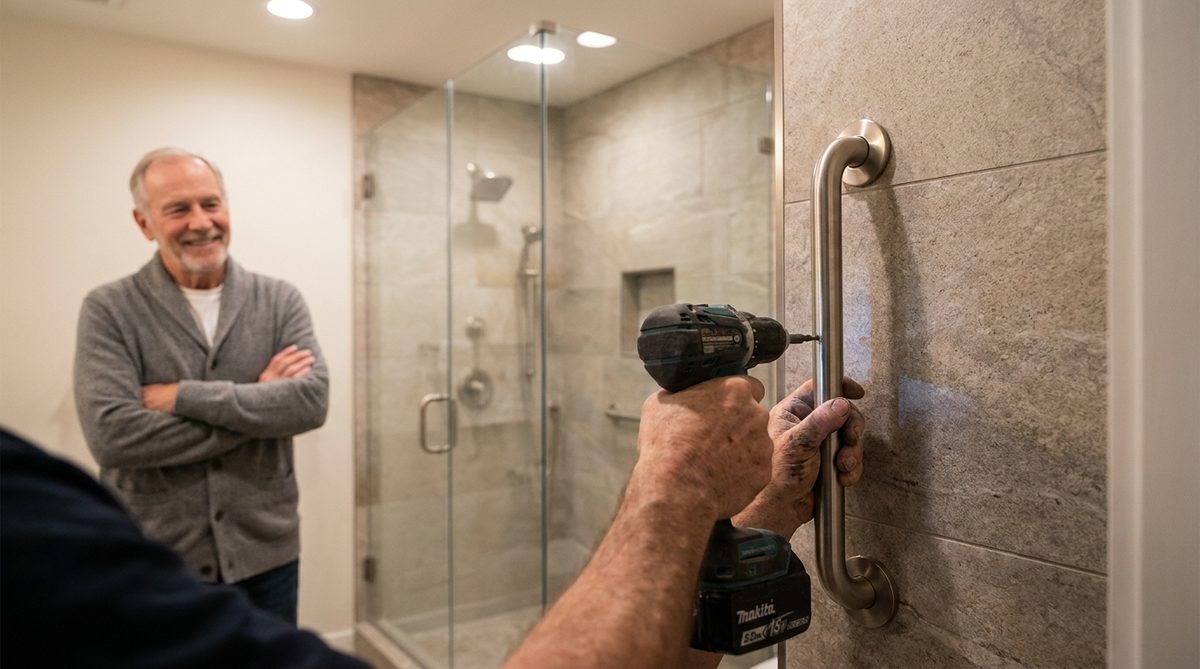
We replaced the tub with a curbless walk-in shower with a built-in bench and a handheld showerhead on a slide bar. We installed three grab bars—not the institutional stainless-steel kind, but sleek, oil-rubbed bronze bars that matched her existing hardware. The toilet was swapped for a comfort-height model (17 to 19 inches). Total cost for the bathroom: approximately $6,800, including labor.
The Entryway: The Problem Nobody Sees
Dorothy’s front door had a four-inch step with no railing. She’d navigated it thousands of times without thinking. But that step, combined with an uneven concrete walkway and poor exterior lighting, was a fall waiting to happen—especially on a rainy Georgia evening.
We added a small ramp with a gentle slope, installed motion-activated LED lights along the path, and put in a lever-style door handle to replace the round knob she’d been struggling to grip. These changes cost under $2,000 and arguably reduced her fall risk more than anything else we did.
The Kitchen: Where Independence Lives
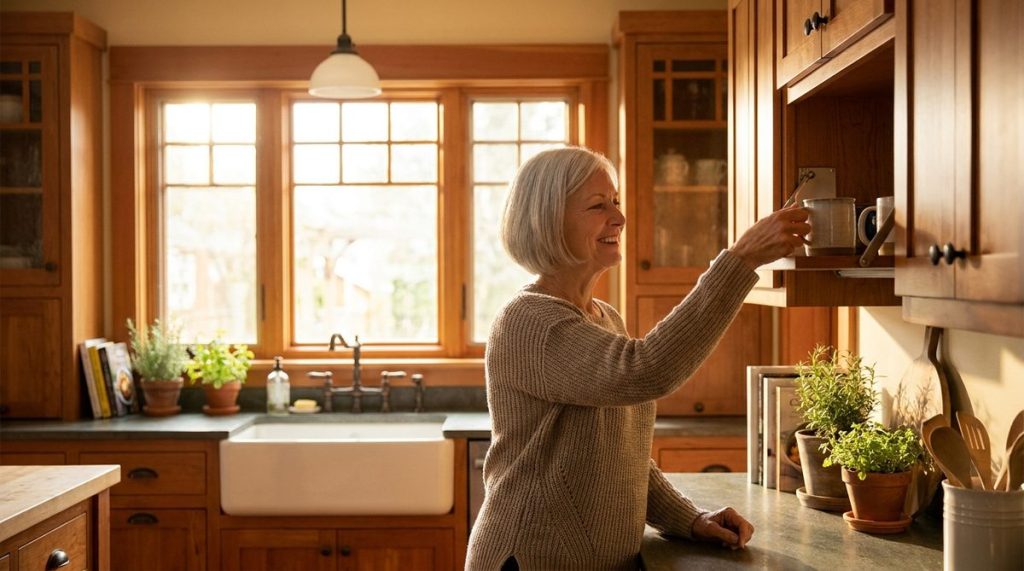
I often tell my clients that the kitchen is where aging in place either works or falls apart. If you can’t safely prepare a meal, your independence erodes fast. Dorothy’s kitchen had upper cabinets she could no longer reach without a step stool—a hazard in itself—and a gas stove with knobs in the back that forced her to lean over hot burners.
We installed pull-down shelf inserts in two upper cabinets, moved her most-used items to lower drawers, and replaced the stove with an induction cooktop with front-mounted controls. The cooktop was the single most expensive item in the entire renovation at $1,200, but it eliminated a burn risk and made cooking enjoyable for Dorothy again.
The Real Cost of Aging in Place—and Why It’s Still Worth It
Let’s talk money, because that’s where most people stall. The total bill for Dorothy’s modifications came to about $14,500. That’s real money. I’m not going to pretend otherwise. And for many retirees managing fixed incomes, it’s a number that causes genuine anxiety—especially when savings are being depleted faster than expected.
But here’s the comparison I always lay out. The median annual cost of a private room in a nursing home in the United States is now over $108,000, according to AARP‘s most recent long-term care cost survey. A semi-private room averages around $94,900. Assisted living facilities average about $64,200 per year. Dorothy’s entire home renovation cost less than two months of nursing home care.
That math isn’t a gimmick. It’s the central financial argument for aging in place, and it holds up almost every time. The modifications pay for themselves within weeks compared to institutional alternatives.
Funding Options Most People Don’t Know About
One of the most frustrating parts of my work is watching people delay critical modifications because they think they can’t afford them—when funding sources exist that they’ve simply never heard of.
- Medicaid Home and Community-Based Services (HCBS) Waivers: Many states cover home modifications for qualifying individuals. The specific programs vary by state, but they can fund grab bars, ramps, widened doorways, and more.
- Veterans Affairs (VA) Grants: The VA offers the Specially Adapted Housing (SAH) grant and the Home Improvements and Structural Alterations (HISA) grant for eligible veterans. The HISA grant can provide up to $6,800 for service-connected disabilities.
- Area Agencies on Aging: Your local AAA often has modest grant programs or can connect you to community organizations that fund modifications. Call the Eldercare Locator at 1-800-677-1116 to find yours.
- Home equity options: A home equity line of credit (HELOC) or a reverse mortgage can fund modifications using the value you’ve already built. These aren’t right for everyone, but they’re worth discussing with a financial advisor.
- Tax deductions: If modifications are medically necessary and prescribed by a physician, they may qualify as deductible medical expenses under IRS rules. Consult a tax professional for specifics.
Beyond the Physical: Technology as a Safety Net
Dorothy’s renovation wasn’t just about hardware. We also introduced a layer of smart home technology that has quietly become one of the most important components of modern aging in place. This is an area that’s evolving fast, and if you haven’t explored it recently, you might be surprised at what’s available—and how affordable it’s become. For a deeper dive, check out this guide on age tech devices that help you age in place.
For Dorothy, we set up a simple system: a voice-activated smart speaker for hands-free calls and reminders, smart plugs on lamps that could be controlled by voice or a phone app, a video doorbell so she could see who was at the door without getting up, and a medical alert pendant she agreed to wear after some gentle persuasion from Linda.
The National Institute on Aging has increasingly emphasized the role of assistive technology in supporting independence, and the research backs it up. A 2023 study published in the Journal of the American Geriatrics Society found that older adults who used even basic smart home devices experienced 30% fewer emergency department visits related to falls compared to a control group.
The Emotional Side Nobody Warns You About
Here’s something I don’t see discussed enough in the aging-in-place conversation: the emotional resistance. Dorothy didn’t want grab bars in her bathroom. She said they’d make her feel old. She resisted the medical alert pendant for the same reason. And when Linda first brought up the idea of modifying the house, Dorothy heard it as, “You can’t take care of yourself anymore.”
I see this tension in almost every family I work with. The adult children are driven by fear. The parent is driven by pride. And both emotions are completely valid.
What I’ve learned is that the framing makes all the difference. When I talked with Dorothy, I didn’t lead with safety. I led with comfort. I asked her what frustrated her about her house. She mentioned the stove knobs. She mentioned hating the tub. She mentioned the front step being annoying in the rain. Once we started solving problems she identified, the safety features became natural additions to solutions she already wanted.
I often tell my clients: don’t sell safety. Sell quality of life. The safety comes built in.
A Practical Starting Point: The Five-Room Walkthrough
If you’re reading this and thinking about your own home—or a parent’s—here’s the exercise I give every new client. Walk through five spaces with fresh eyes and ask one question in each: What makes this harder than it needs to be?
- Bathroom: Can you get in and out of the shower or tub without holding onto something that isn’t bolted down? Is the floor slippery? Is the toilet hard to sit down on or stand up from?
- Kitchen: Are you using a step stool to reach daily items? Do you have to lean over a hot surface? Is the lighting adequate for reading labels and handling knives?
- Entryway: Are there steps without railings? Is the path well-lit at night? Can you open the door easily while carrying groceries?
- Bedroom: Is your bed too high or too low to get in and out of comfortably? Is there a clear, uncluttered path from the bed to the bathroom? Can you reach a light switch from the bed?
- Stairways: Are railings on both sides? Are treads even and non-slip? Is there adequate lighting at the top and bottom?
This walkthrough takes 20 minutes and will reveal 80% of the issues a professional assessment would find. It won’t replace an expert evaluation—but it’ll tell you whether it’s time to schedule one.
Where Dorothy Is Now
I checked in with Linda in March. Dorothy has been back in her home since December. She hasn’t fallen. She’s cooking again—she made chicken piccata for Linda’s visit, which apparently is a big deal in their family. She uses the grab bars without thinking about them. She actually likes the video doorbell because she can see when the mail carrier comes without getting up from her chair.
The medical alert pendant? She wears it every day. She told Linda it makes her feel safer walking to the mailbox. That’s a sentence that would have been unthinkable in October.
Dorothy’s story isn’t dramatic. There’s no miracle technology, no six-figure renovation, no radical lifestyle change. It’s a story about a house that was gently, thoughtfully adapted to the person living in it—and that person getting to keep the life she’d built there. If you’re thinking about your own home and what it might need to keep supporting you, or if you want to understand common aging in place myths that could cost you thousands, now is the time to start that conversation. Not after the fall. Before it.
That’s what aging in place actually looks like. And after 14 years of doing this work, I can tell you: it works. Not perfectly, not for everyone, not without effort and investment—but for the vast majority of older adults who want to stay in their homes, the path is there. You just have to walk through the house with honest eyes and start making it ready.
About Marcus Bell, Certified Aging-in-Place Specialist (CAPS)
Marcus Bell is a Certified Aging-in-Place Specialist (CAPS) with 14 years of experience helping American seniors create safer, more comfortable living environments. He has consulted on hundreds of home modifications — from bathroom safety upgrades to smart home installations — and writes extensively about the products, services, and strategies that help older adults live independently for longer. At Daily Trends Now, Marcus covers home improvement, aging-in-place solutions, gardening, and practical lifestyle tips for seniors.