


The Phone Call That Almost Cost Margaret $47,000
Margaret Kowalski, a 72-year-old retired teacher in Scottsdale, Arizona, picked up her phone on a Tuesday afternoon last March and heard her grandson crying. “Grandma, I’ve been in a car accident. I’m in jail. Please don’t tell Mom and Dad,” the voice pleaded. Margaret’s heart seized. She knew that voice — the slight rasp, the way he said “Grandma” with the emphasis on the second syllable. She was reaching for her purse when something stopped her.
Her grandson had called her the night before to talk about his new job. He was 1,400 miles away in Chicago. So she hung up and called him directly. He answered on the second ring, perfectly fine, completely unaware of any accident. The voice on that first call wasn’t her grandson at all. It was an AI-generated clone, built from audio clips scraped from his social media videos.
Margaret was nearly a victim of one of the fastest-growing criminal enterprises in America: AI-powered elder fraud. And in my 14 years working in cybersecurity and digital privacy research, I have never seen the threat landscape shift this fast — or this dangerously — for older adults.
The Staggering Scale of Elder Fraud in America
The FBI’s Internet Crime Complaint Center (IC3) released its 2024 Elder Fraud Report earlier this year, and the numbers are genuinely alarming. Americans over 60 reported losses exceeding $4.8 billion to fraud — a 43% increase from 2023. More than 147,000 complaints were filed, but the FBI estimates that figure represents only a fraction of actual incidents because shame and embarrassment keep many victims silent.
What I see most often in my research is a dangerous gap between perception and reality. Many older adults believe scams are obvious — the Nigerian prince email, the too-good-to-be-true sweepstakes letter. But today’s scammers have abandoned those clumsy approaches. They’re using artificial intelligence, deepfake audio, spoofed phone numbers, and sophisticated social engineering that can fool anyone, regardless of education or tech savviness.
And the financial consequences don’t exist in a vacuum. When retirees lose tens of thousands of dollars to fraud, it compounds the pressure they already face from inflation draining retirement savings and the stealth Social Security cuts that have quietly eroded benefits by 13.7%. A single scam can undo years of careful financial planning.
How AI Has Supercharged Scams Targeting Older Adults
The reason elder fraud rises as scammers use AI isn’t complicated: artificial intelligence makes deception cheaper, faster, and devastatingly more convincing. Here’s what’s changed in just the last 18 months.
Voice Cloning: The Grandparent Scam, Perfected
Margaret’s story isn’t unusual anymore. Voice cloning technology now needs as little as three seconds of audio to generate a convincing replica of someone’s voice. Scammers pull clips from TikTok videos, Instagram Reels, YouTube vlogs, even voicemail greetings. A 2024 study by McAfee found that 77% of AI voice scam victims lost money, with one in ten reporting losses over $5,000.
The classic grandparent scam — “Grandma, I’m in trouble, send money” — has existed for decades. But when the voice on the phone sounds exactly like your grandchild, the emotional override is almost impossible to resist. Scammers know this. They’re counting on it.
AI-Generated Phishing Emails and Texts
Remember when phishing emails were riddled with typos and awkward grammar? Those days are over. Large language models can now generate flawless, personalized phishing messages that reference your real bank, your actual recent purchases, or local events in your community. I’ve reviewed phishing emails in my lab that I had to look at twice myself — and this is literally my job.
Deepfake Video Calls
This is the frontier that terrifies me most. Scammers have begun using real-time deepfake video to impersonate bank officials, government agents, and even family members on video calls. In February 2024, a finance worker in Hong Kong was tricked into transferring $25 million after a video call with what appeared to be his company’s CFO — entirely AI-generated. While that case involved a corporate target, the same technology is being adapted for consumer scams targeting older adults.

The Top 5 AI-Enhanced Scams Targeting Older Adults Right Now
Based on FBI data, FTC reports, and my own research, these are the most dangerous scams currently targeting Americans over 50:
| Scam Type | How AI Makes It Worse | Average Loss Per Victim | Red Flag to Watch For |
|---|---|---|---|
| Grandparent / Family Emergency | AI voice cloning mimics a loved one’s voice | $7,500 – $50,000+ | Urgency, secrecy, requests for cash or gift cards |
| Tech Support Fraud | AI chatbots impersonate real support agents with personalized scripts | $15,000 – $25,000 | Pop-up warnings, unsolicited calls claiming “your computer is infected” |
| Romance / Companion Scams | AI generates realistic profile photos, maintains text conversations 24/7 | $14,000 – $180,000 | Online-only relationship, requests for crypto or wire transfers |
| Government Impersonation | Spoofed caller ID + AI voice mimics IRS or SSA agents | $8,000 – $30,000 | Threats of arrest, demands for immediate payment |
| Investment / Crypto Fraud | Deepfake celebrity endorsements, AI-generated fake trading platforms | $50,000 – $500,000+ | Guaranteed returns, pressure to invest quickly |
The FTC’s Consumer Advice division reported that investment scams accounted for the highest dollar losses in 2024, while tech support scams remained the most frequently reported. What ties them together now is the use of AI to scale attacks and personalize them in ways that weren’t possible even two years ago.
Why Older Adults Are Targeted — And Why It’s Not About Being “Gullible”
I often tell my clients something that surprises them: being targeted by a scammer has nothing to do with intelligence. Older adults are targeted for very specific, strategic reasons that have nothing to do with naivety.
- Accumulated wealth: Americans over 60 hold more than $22 trillion in assets — more than any other age group. Scammers go where the money is.
- Predictable routines: Retirees are more likely to answer unfamiliar phone calls during the day, giving scammers a larger window.
- Social isolation: A 2023 National Academies report found that roughly one-quarter of adults 65 and older are socially isolated. Loneliness makes people more vulnerable to romance scams and fake companionship.
- Unfamiliarity with new technology: AI voice cloning, deepfakes, and sophisticated phishing tactics exploit a knowledge gap — not an intelligence gap.
- Politeness and trust: Generational norms around courtesy mean many older adults are less likely to hang up on a caller or question authority figures.
Understanding why you’re targeted is the first step toward not being victimized. There are also persistent scam myths that put your money at real risk — like the idea that scammers only target people who aren’t tech-savvy. Plenty of sophisticated, computer-literate retirees have lost six figures to well-crafted schemes.
Your AI-Age Defense Plan: Practical Steps That Actually Work
After years of studying these attacks and helping victims recover, I’ve developed what I call a layered defense approach. No single trick will protect you — but combining several strategies makes you an extremely hard target.
Create a Family Code Word
This is the single most effective defense against AI voice cloning scams. Choose a code word or phrase that only your family knows — something that wouldn’t appear on social media or in any public conversation. If someone calls claiming to be a family member in distress, ask for the code word. No code word, no money. Period.
Make the code word memorable but not guessable. “Purple kangaroo” works. Your pet’s name does not — that information is likely already online.
Adopt the “Hang Up and Call Back” Rule
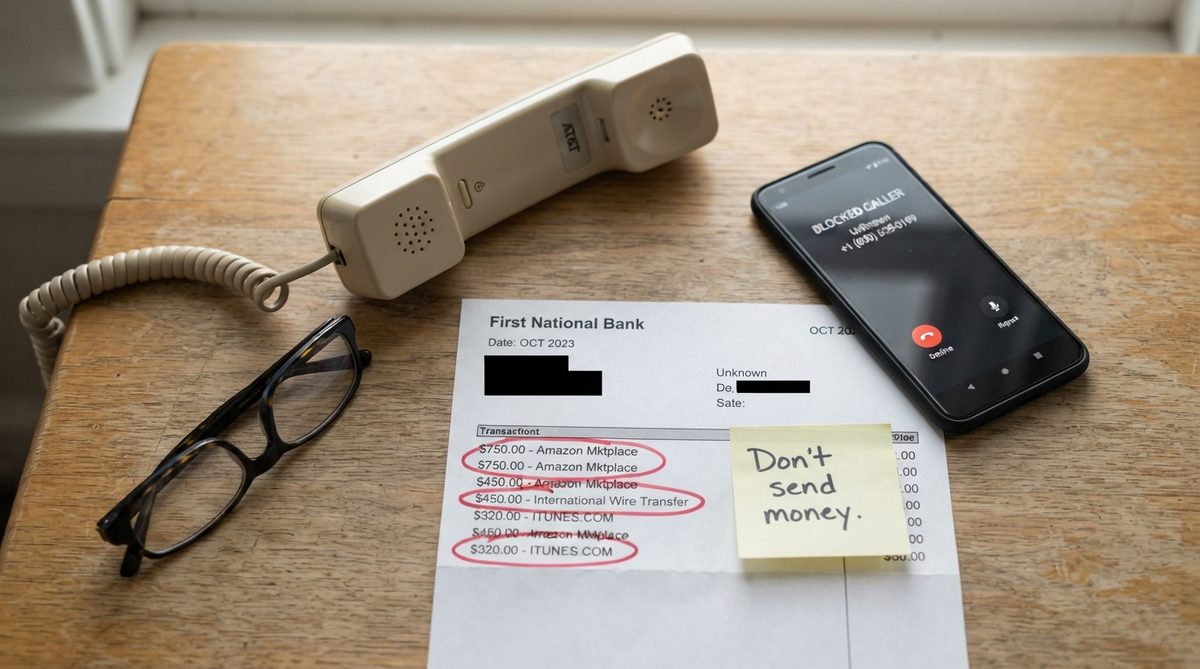
If you receive any call requesting money, personal information, or urgent action — hang up. Then independently look up the real phone number for whoever supposedly called (your bank, the IRS, your grandchild) and call them directly. Scammers spoof caller ID routinely. The number displayed on your phone means absolutely nothing.
Lock Down Your Financial Accounts
Contact your bank and brokerage and ask about these specific protections:
- Verbal passwords: Set up a verbal password that must be provided before any large transaction is processed over the phone.
- Transaction alerts: Enable text or email alerts for any withdrawal or transfer over $100.
- Trusted contact designation: Under SEC rules, you can designate a trusted contact person on your investment accounts. This person can be contacted if the firm suspects financial exploitation.
- Transfer delays: Some banks now offer a 24-hour hold on wire transfers requested by phone — opt in if available.
Harden Your Digital Presence
Scammers research their targets. The less information available about you online, the harder it is to craft a personalized attack.
- Set all social media profiles to private — especially those of your grandchildren, whose voices and images can be cloned.
- Remove your phone number and address from data broker sites like Spokeo, WhitePages, and BeenVerified. The FTC has guides on how to submit removal requests.
- Never post travel plans publicly. “Heading to Maui for two weeks!” is an invitation for scammers who know your house will be empty.
- Use unique, strong passwords for every account. A password manager like Bitwarden (free) or 1Password makes this easy.
Enable Two-Factor Authentication Everywhere
Two-factor authentication (2FA) means that even if a scammer steals your password, they still can’t get into your account without a second verification step — usually a code sent to your phone. Enable it on your email, bank, and social media accounts at minimum. In my experience, this single step blocks more than 90% of account takeover attempts.
If you’re still getting comfortable with smartphones and want to learn how they can work for you rather than against you, our guide on 7 ways smartphones help older adults stay independent covers the basics with zero jargon.
What to Do If You’ve Already Been Scammed
If you suspect you’ve been a victim — or even if you’re not sure — act immediately. Speed matters enormously in fraud recovery.
- Contact your bank or credit card company within 24 hours. Many institutions can reverse or freeze transactions if notified quickly.
- File a report with the FBI’s IC3 at ic3.gov. This is the primary federal database for internet-related fraud, and your report helps investigators track patterns.
- Report to the FTC at ReportFraud.ftc.gov.
- Call the Eldercare Locator at 1-800-677-1116. This free service connects you with local agencies that assist with elder fraud cases.
- Place a fraud alert on your credit reports through Equifax, Experian, or TransUnion. You only need to contact one — they’re required to notify the others.
- Don’t be ashamed. I cannot emphasize this enough. Scammers are professional criminals using military-grade technology. Reporting isn’t embarrassing — it’s brave, and it protects the next potential victim.
The Bigger Picture: Why This Problem Is Getting Worse Before It Gets Better
As a researcher, I track how quickly AI fraud tools evolve. In January 2023, creating a convincing voice clone required specialized software and technical expertise. By mid-2025, there are free apps that can do it in under 30 seconds. The barrier to entry for criminals has essentially collapsed.
Congress has introduced several bills aimed at criminalizing the malicious use of AI-generated media, including the DEFIANCE Act and the NO FAKES Act. But legislation moves slowly, and enforcement across international borders — where many scam operations are based — remains extraordinarily difficult.
The uncomfortable truth is that for the foreseeable future, your best defense is you. Awareness, skepticism, and a few deliberate protective habits will do more to keep you safe than any law or software currently available.
One Final Story
I’ll leave you with what happened after Margaret Kowalski’s near-miss. She didn’t just dodge a scam — she became her community’s unofficial fraud educator. She started a monthly coffee group at her local library where she and a dozen friends share the latest scam tactics they’ve encountered. They call themselves the “Scam Busters,” and they’ve reported over 40 fraud attempts to the FBI in the past year.
When I spoke with Margaret for this article, she told me something I think about often: “The scammer was counting on me being afraid and alone. I wasn’t going to give him either one.”
That’s the attitude that works. Stay informed. Stay connected. Stay skeptical. And when something feels wrong — trust that feeling, hang up, and verify.
Frequently Asked Questions
Can AI really clone someone's voice from just a few seconds of audio?
Yes. Current AI voice cloning tools can produce a convincing replica from as little as three seconds of recorded audio. Scammers commonly pull voice samples from social media videos, voicemail greetings, and video calls. This is why cybersecurity experts recommend setting social media profiles to private and establishing a family code word that would never appear in any public recording.
Will my bank refund me if I lose money to an AI-powered scam?
It depends on how the money was sent. Banks can often reverse unauthorized credit card charges and sometimes recover wire transfers if reported within 24 hours. However, money sent via gift cards, cryptocurrency, or peer-to-peer apps like Zelle is extremely difficult to recover. Contact your bank immediately — the faster you act, the better your chances.
How can I tell if a phone call is using an AI-cloned voice?
AI-cloned voices still have subtle tells: slight robotic undertones, unnatural pauses, or a lack of background noise. But the technology is improving rapidly, so don't rely on your ear alone. Instead, use behavioral verification — ask the caller your family code word, hang up and call the person directly at a number you already have saved, or ask a question only the real person would know. If the caller pressures you not to verify, that itself is a major red flag.
About Dr. Priya Sharma, PhD in Computer Science, CISSP
Dr. Priya Sharma is a cybersecurity expert with a PhD in Computer Science and a Certified Information Systems Security Professional (CISSP) credential. She has spent 14 years researching digital privacy, online fraud, and data protection — with a particular focus on the risks facing older internet users. At Daily Trends Now, Dr. Sharma writes about online scams, password security, smartphone privacy, and the practical steps readers can take to stay safe in an increasingly connected world.