

Key Takeaways
- You can make meaningful aging-in-place modifications to your home for $1,500 or less by prioritizing high-impact safety upgrades first.
- Grab bars, lever-style door handles, and improved lighting are the three most cost-effective changes that dramatically reduce fall risk.
- A phased approach to home modifications lets you spread costs over time instead of facing one overwhelming renovation bill.
- Technology solutions like smart home devices and medical alert systems can supplement physical modifications and extend independent living by years.
The Phone Call That Changed Everything
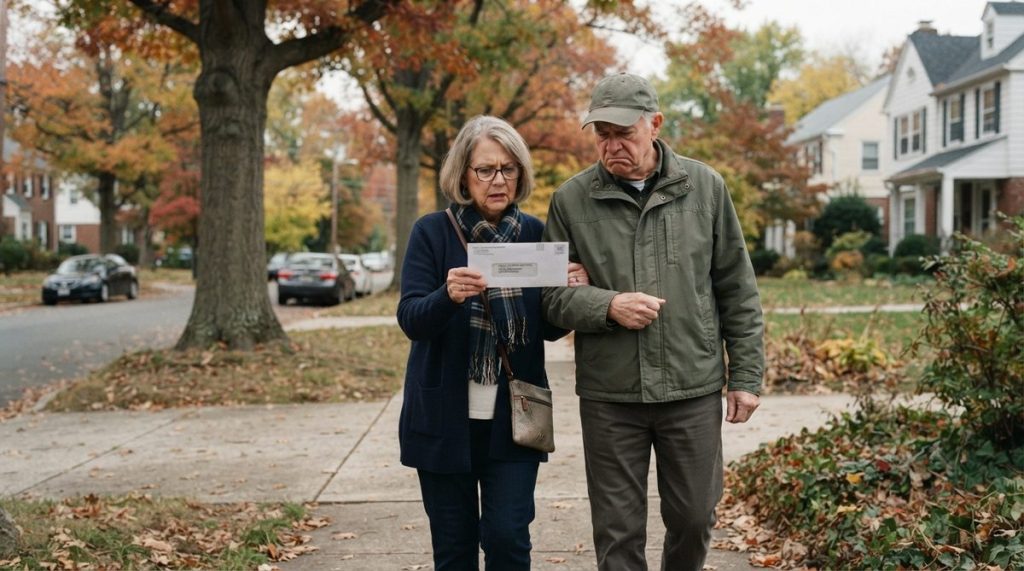
Last March, I got a call from a woman named Gloria in Richmond, Virginia. She was 71, recently widowed, and terrified. Not of being alone—she’d made peace with that. She was terrified of losing her home.
“My daughter wants me to move into assisted living,” Gloria told me, her voice cracking. “But this is where I raised my kids. This is where Frank and I built our life. I’m not ready to leave.”
The problem wasn’t sentimental. It was practical. Gloria had slipped getting out of her bathtub the week before. She caught herself on the towel bar—which promptly ripped out of the drywall. No injury that time, but her daughter saw the hole in the wall and panicked. The conversation shifted from “Are you okay?” to “You can’t live here anymore.”
I hear some version of Gloria’s story at least twice a month. In my 14 years as a Certified Aging-in-Place Specialist, the pattern is almost always the same: a scare happens, a family member reacts, and suddenly a person who is perfectly capable of independent living feels like they’re one grab bar away from a nursing home. The truth? They’re usually right—but in the opposite direction. One grab bar, properly installed, could be exactly what keeps them home for another decade.
The Real Cost of Aging in Place (It’s Not What You Think)
Here’s the headline that keeps circulating: age-proofing a home is expensive. And yes, if you’re talking about a full-scale renovation—widening doorways for wheelchair access, installing a roll-in shower, adding an elevator—you could easily spend $25,000 to $100,000. According to AARP, the average cost of major home modifications ranges from $10,000 to $50,000 depending on the scope.
But what I see most often is that people hear those numbers and freeze. They do nothing. And doing nothing is the most expensive choice of all.
“A single fall-related hip fracture costs an average of $35,000 to $40,000 in medical expenses. The grab bar that might have prevented it costs $25 and takes 30 minutes to install properly.”
The key word in “how to set up your home to age in place” isn’t “home.” It’s “set up.” It implies a process—something you build over time, not a one-weekend panic project after a fall. And when you approach it as a process, the costs become remarkably manageable.
Gloria’s total bill for her first round of modifications? $1,340. That bought her safety, independence, and—most importantly—the confidence to tell her daughter, “I’ve got this handled.”
Start Where the Danger Is: The Bathroom
If you do one thing after reading this article, let it be this: fix your bathroom. The National Council on Aging reports that one in four Americans aged 65 and older falls each year, and the bathroom is the single most dangerous room in the house for older adults. Wet floors, hard surfaces, awkward transitions in and out of the tub—it’s an obstacle course disguised as a place to get clean.
The $200 Bathroom That Could Save Your Life
Here’s what I recommended for Gloria, and what I recommend for almost every client starting out:
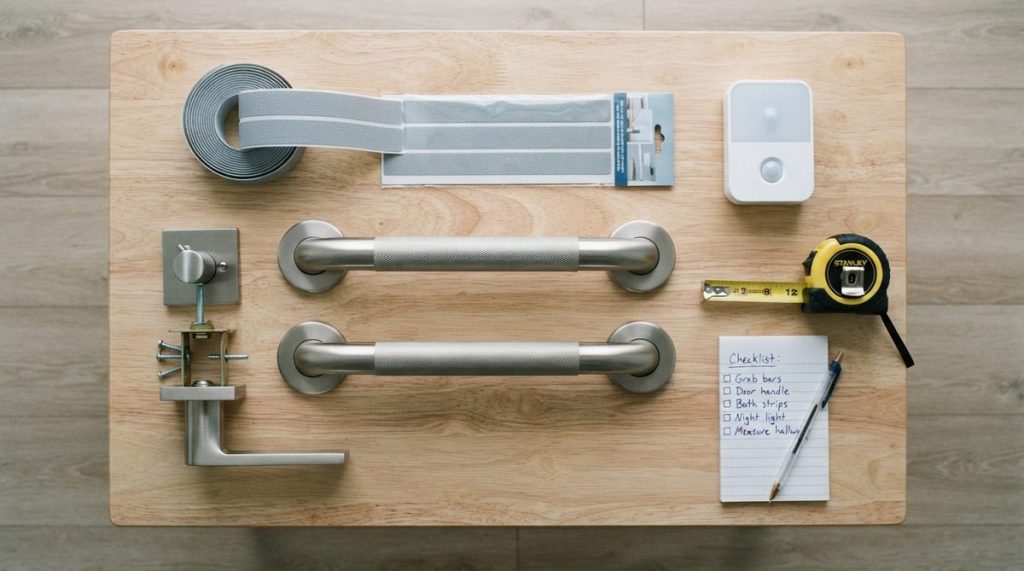
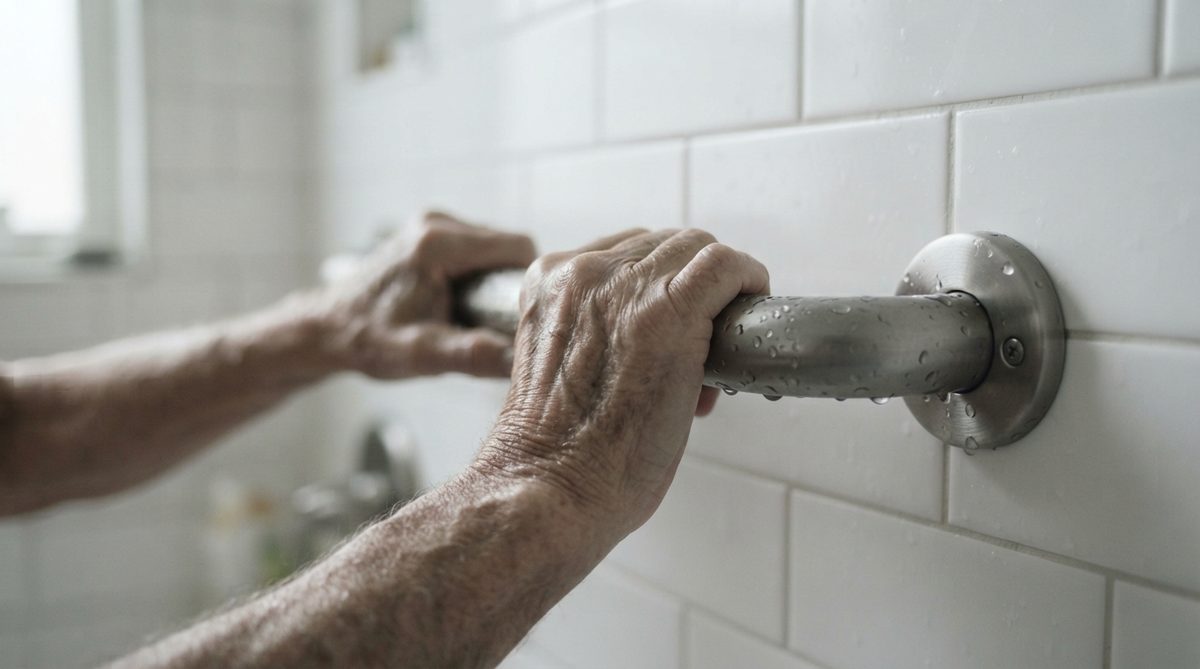
- Two wall-mounted grab bars — one inside the shower/tub area, one next to the toilet. Cost: $40–$80 total. These must be screwed into wall studs or use toggle bolts rated for at least 250 pounds. Suction-cup grab bars are not safe. Period.
- A non-slip bath mat or adhesive strips — inside the tub or shower floor. Cost: $10–$25.
- A handheld showerhead — allows you to sit while bathing if needed. Cost: $25–$50. Most screw onto existing fixtures without a plumber.
- A shower bench or transfer seat — for anyone with balance concerns. Cost: $35–$80.
- A raised toilet seat — reduces the depth of the sit-to-stand motion, which is where most bathroom falls happen. Cost: $30–$60.
Total investment: roughly $140–$295. Installation time: a Saturday afternoon. Impact: potentially life-saving.
When to Call a Professional
If your bathroom has a traditional tub that requires stepping over a high wall, eventually you may want to consider a walk-in shower conversion. That’s a bigger project—typically $3,000 to $8,000—but it doesn’t have to happen on day one. The grab bars and bench buy you time to plan and budget for that upgrade later. If you’re concerned about managing the cost of larger renovations over time, it’s worth reviewing how to protect retirement savings from inflation so your renovation fund doesn’t lose purchasing power while you save.
Lighting: The Modification Nobody Talks About
I often tell my clients that the cheapest safety upgrade in any home is a light bulb. That sounds like a joke, but I’m dead serious. Poor lighting is a contributing factor in a staggering number of falls among older adults, yet it barely gets mentioned in most aging-in-place guides.
As we age, our eyes need significantly more light to see the same details. A 60-year-old typically needs three times more light than a 20-year-old to navigate the same space safely. By 75, that number climbs even higher.
A Room-by-Room Lighting Checklist
- Hallways and staircases — Install motion-sensor LED night lights every 8–10 feet. Cost: $8–$15 each. These eliminate the most dangerous scenario: walking through a dark hallway at 2 a.m. to reach the bathroom.
- Kitchen — Add under-cabinet LED strip lights to illuminate countertops and reduce shadows where knives and hot surfaces lurk. Cost: $15–$40 for peel-and-stick battery-operated strips.
- Stairways — Ensure light switches exist at both the top and bottom of every staircase. If they don’t, a wireless switch kit costs about $20 and requires no electrical work.
- Exterior entries — Install a motion-activated porch light. Finding your keyhole in the dark while holding groceries is a fall waiting to happen. Cost: $25–$50.
Gloria spent $87 on lighting. She told me it was the modification she noticed the most. “I didn’t realize how much I’d been squinting and guessing,” she said. “Now I can actually see my own house.”
Floors, Thresholds, and the Tripping Epidemic
After bathrooms and lighting, I turn my attention to what’s underfoot. Loose rugs are responsible for more emergency room visits among older adults than most people would believe. The National Institute on Aging specifically recommends removing throw rugs or securing them with double-sided carpet tape as a primary fall-prevention strategy.
Walk through every room of your home and look down. What do you see?
- Loose area rugs — Remove them entirely or secure them with non-slip rug pads and carpet tape. Better yet, remove them. I know that’s hard to hear if you love your rugs, but I’ve seen too many people trip on curled corners.
- Raised thresholds between rooms — These can be planed down, replaced with low-profile transitions, or highlighted with contrasting color tape so they’re visible. Cost: $10–$50 per threshold.
- Electrical cords crossing walkways — Reroute them along walls or use cord covers. This is a $5 fix that prevents a $35,000 hip fracture.
- Clutter on stairs — Books, shoes, laundry baskets. If it’s on a step, it’s a hazard. No exceptions.
Doors, Handles, and the Art of Easy Access
Round doorknobs are quietly hostile to aging hands. Arthritis, reduced grip strength, even temporary conditions like carpal tunnel—all of them make round knobs difficult or painful to operate. Lever-style handles solve this completely, and they’re one of the easiest swaps in home modification.
A set of interior lever handles costs $12–$30 per door and requires only a screwdriver to install. For most homes, converting the 8–10 most-used doors runs $100–$250 total. I also recommend lever handles on exterior doors, along with a keyless entry system so you’re never fumbling with a tiny key in cold or wet weather.
“The goal of aging in place isn’t to make your home look like a hospital. It’s to make your home work as well at 80 as it did at 50—just with smarter design.”
This philosophy extends to kitchen cabinets (replace knobs with D-shaped pulls), faucets (single-lever instead of two-handle), and even appliance choices (front-loading washer/dryer to eliminate bending and reaching).
The Technology Layer: Smart Doesn’t Mean Complicated
I used to be skeptical about technology as an aging-in-place solution. Too many of my clients in their 60s and 70s would tell me, “I’m not a tech person.” But the tools available in 2025 and 2026 have gotten remarkably simple, and they fill gaps that physical modifications can’t.
A few worth considering:
- Medical alert systems — Modern versions are wearable, waterproof, and include automatic fall detection. Monthly cost: $25–$45. This is non-negotiable for anyone living alone.
- Smart speakers — Voice-activated assistants can set medication reminders, make emergency calls, control lights and thermostats, and even provide companionship through music and audiobooks. Cost: $30–$80 for the device.
- Video doorbells — See who’s at the door without getting up or opening it. This is both a safety and a security measure. Cost: $40–$100.
- Smart lighting — Bulbs or plugs that respond to voice commands or schedules, so you never have to cross a dark room to reach a switch. Cost: $10–$20 per bulb.
For a deeper look at how today’s devices support independent living, I’d recommend reading about how technology helps older adults stay independent in 2025—it covers options I don’t have space to get into here.
The Phased Approach: Gloria’s Timeline
Let me return to Gloria’s story, because her approach is exactly what I recommend to anyone asking how to set up your home to age in place without financial stress.
Month 1 (spent: $340) — Bathroom grab bars, non-slip mat, handheld showerhead, raised toilet seat. This addressed the immediate danger that triggered the whole conversation.
Month 2 (spent: $87) — Lighting upgrades throughout the house. Motion sensors in the hallway, under-cabinet lights in the kitchen, new porch light.
Month 3 (spent: $215) — Lever handles on 10 interior doors. Removed three area rugs. Secured one runner with carpet tape. Installed cord covers in the living room.
Month 4 (spent: $698) — Installed a stairlift handrail reinforcement, a video doorbell, and a medical alert pendant. Set up a smart speaker in the kitchen and bedroom.
Four months. $1,340. No contractors except for the grab bar installation, which her neighbor—a retired handyman—did for free. Gloria’s daughter visited after the changes were complete and actually cried. Not from worry this time. From relief.
What About the Big-Ticket Items?
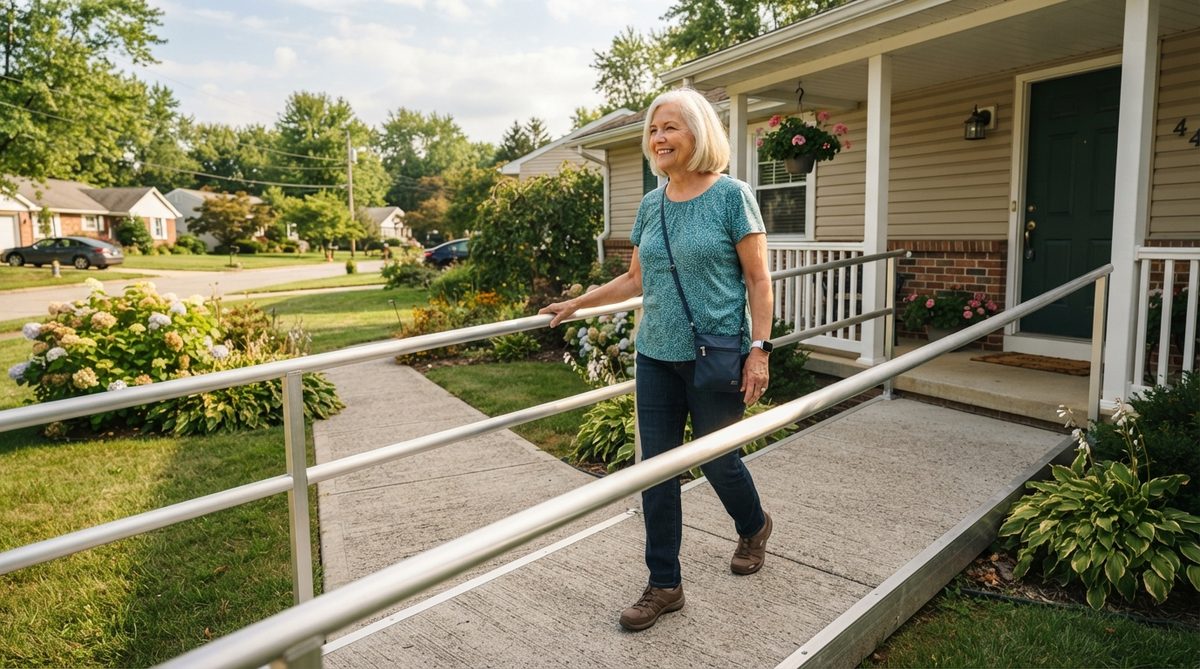
I won’t pretend that $1,500 covers everything forever. As mobility needs change, larger modifications may become necessary. Walk-in showers, first-floor bedroom conversions, exterior ramps, wider doorways for walkers or wheelchairs—these are significant investments.
But here’s what I want you to understand: the small modifications aren’t just a stopgap. They’re the foundation. Every grab bar you install, every rug you remove, every light you add is buying you time—time to save, time to plan, and time to live independently while you do it.
Some financial strategies to consider for larger future modifications:
- Medicaid Home and Community-Based Services waivers — In many states, these cover home modifications for eligible individuals. Requirements vary by state, so check with your local Area Agency on Aging.
- VA grants — Veterans may qualify for the Specially Adapted Housing (SAH) or Home Improvements and Structural Alterations (HISA) grants.
- USDA Rural Development loans — Available to homeowners in qualifying rural areas for home repairs and modifications.
- Nonprofit programs — Organizations like Rebuilding Together provide free home modifications to low-income older adults in communities across the country.
And if you’re budgeting for future renovations, keep in mind that inflation affects construction costs, too. Understanding how to stop inflation from depleting retirement savings is directly relevant to anyone planning a major home modification down the road.
The Conversation You Need to Have—With Yourself
The biggest barrier to aging in place isn’t money. It isn’t even the physical condition of your home. It’s denial. I’ve walked through homes with clients who pointed to steep basement stairs and said, “Oh, I’m fine on those.” They’re fine—until they’re not.
The best time to set up your home to age in place is before you need it. At 55 or 60, these modifications feel like smart upgrades. At 80, after a fall, they feel like desperate catch-up. The emotional difference is enormous, and so is the practical one. Planning ahead means you choose what you want. Reacting to a crisis means you take what you can get.
Gloria called me again last month. She’s 72 now, still in her home, still independent, and she just signed up for a watercolor class at the community center. “I told my daughter I’m not going anywhere,” she said, laughing. “I’ve got grab bars.”
She does. And so can you.
About Marcus Bell, Certified Aging-in-Place Specialist (CAPS)
Marcus Bell is a Certified Aging-in-Place Specialist (CAPS) with 14 years of experience helping American seniors create safer, more comfortable living environments. He has consulted on hundreds of home modifications — from bathroom safety upgrades to smart home installations — and writes extensively about the products, services, and strategies that help older adults live independently for longer. At Daily Trends Now, Marcus covers home improvement, aging-in-place solutions, gardening, and practical lifestyle tips for seniors.