


The $3.4 Billion Problem Hiding in Plain Sight
Here’s a statistic that should stop every American over 50 in their tracks: adults aged 60 and older reported losing $3.4 billion to fraud in 2023, according to the FBI’s Internet Crime Complaint Center (IC3). That figure represents a 11% increase from the prior year — and the FBI estimates actual losses are significantly higher because the majority of victims never report the crime.
In my 14 years working in cybersecurity and digital privacy research, I’ve watched these numbers climb relentlessly. But what disturbs me most isn’t the dollar amount — it’s the sophistication gap. The scams targeting older adults in 2025 are radically different from the clumsy Nigerian prince emails of a decade ago. Today’s fraudsters use AI-generated voices, spoofed caller IDs, and deepfake video to exploit trust in ways that can fool even tech-savvy professionals.
This article isn’t a scare piece. It’s a data-driven analysis of the five most dangerous financial scams targeting older adults right now, with concrete defensive strategies that actually work. I’ve reviewed federal enforcement data, academic research, and hundreds of real victim reports to compile what follows.
Why Older Adults Are Disproportionately Targeted
Before diving into specific scams, it’s worth understanding why criminals focus so heavily on Americans over 50. The answer isn’t cognitive decline — that’s a harmful stereotype. The real reasons are structural and financial.
Adults over 60 control approximately 70% of all disposable income in the United States. They’re more likely to own homes outright, hold substantial retirement savings, and have excellent credit scores. From a criminal’s perspective, this demographic represents the highest-value targets with the most accessible assets.
There’s also a generational trust factor. What I see most often is that adults who grew up before the internet era tend to extend the same social courtesies online that they would in person — answering calls from unknown numbers, engaging politely with strangers who reach out, and trusting that institutions contacting them are legitimate. Scammers weaponize that courtesy ruthlessly.
If you’re concerned about protecting your financial foundation from multiple threats, including fraud, you may also want to review how 7 Ways to Stop Inflation From Draining Your Retirement Savings can help shore up your broader financial defenses.
The Five Most Dangerous Scams of 2025: A Data Breakdown
Based on FBI IC3 data, FTC Consumer Advice reports, and my own research analysis, these are the five fraud categories causing the greatest financial harm to older Americans right now.
| Scam Type | Median Loss Per Victim (60+) | Year-Over-Year Growth | Primary Contact Method | Recovery Rate |
|---|---|---|---|---|
| Tech Support Fraud | $14,000 | +15% | Phone / Pop-up Ads | Very Low (~8%) |
| Investment / Crypto Scams | $83,000 | +71% | Social Media / Text | Extremely Low (~3%) |
| Romance / Confidence Fraud | $27,000 | +22% | Dating Apps / Facebook | Low (~5%) |
| Government Impersonation | $8,500 | +12% | Phone Calls | Moderate (~15%) |
| Grandparent / Family Emergency | $9,500 | +35% (AI-driven surge) | Phone (AI voice cloning) | Low (~6%) |
Let me walk through each of these in detail, because understanding the mechanics is the single best defense.
Tech Support Fraud: The Gateway Scam
This remains the most common scam affecting older adults by volume. The typical scenario: a pop-up appears on your computer screen claiming your device is infected. A phone number is displayed. When you call — or when a “technician” calls you — they request remote access to your machine.
Once inside, the scammer may show you fabricated “evidence” of hacking, install actual malware, or access your banking credentials directly. In 2023, the FBI recorded over 37,500 tech support fraud complaints from victims over 60, with losses exceeding $590 million.
The 2025 evolution is alarming. Scammers now purchase legitimate-looking Google and Bing ads that appear when someone searches for help with a real product — “Apple support phone number,” for example. The search result looks authentic. The phone number connects to a criminal.
Your defense:
- Never call a phone number displayed in a pop-up window — close the browser entirely (use Ctrl+Alt+Delete if needed)
- Bookmark official support pages for products you use (Apple, Microsoft, your bank) so you never need to search for them
- No legitimate company will ever call you unsolicited to report a computer problem
- If someone requests remote access to your device, hang up immediately — no exceptions
Investment and Cryptocurrency Scams: The Highest Dollar Losses
This category has exploded. The median loss of $83,000 among older adults makes it by far the most financially devastating scam type. These schemes often begin with a casual social media message or an online advertisement promising exceptional returns.
What makes these scams so effective is the patience of the operators. I often tell my readers: the most dangerous scammers don’t ask for money immediately. They build a relationship over weeks. They may direct you to a professional-looking website or app where you can “watch” your investment grow. The numbers on the screen are entirely fabricated.
When you try to withdraw funds, you’re told you need to pay “taxes” or “fees” first. By the time victims realize the entire platform is fake, the money — often sent via cryptocurrency or wire transfer — is gone.
Romance and Confidence Fraud: Exploiting Loneliness
Approximately 1 in 3 Americans over 65 reports feeling lonely regularly, according to data from the National Academies of Sciences. Scammers exploit this aggressively through dating apps, Facebook groups, and even Words With Friends chat features.
The 2025 twist: AI-generated profile photos that are virtually undetectable and real-time language translation that allows overseas scam operations to communicate flawlessly in American English. Some operations now use AI chatbots to maintain simultaneous “relationships” with hundreds of victims.
Red flags that should trigger immediate caution:
- The person claims to be a U.S. military member stationed overseas
- They profess deep emotional attachment within days or weeks
- A crisis emerges requiring urgent financial help — medical bills, travel costs, legal fees
- They consistently avoid video calls or in-person meetings
- They ask you to receive and forward money or packages
Government Impersonation: Fear as a Weapon
Calls from “Social Security,” the “IRS,” or “Medicare” claiming your benefits are suspended, your Social Security number has been compromised, or you owe back taxes that must be paid immediately via gift cards or wire transfer. These calls often spoof legitimate government phone numbers.
CISA (the Cybersecurity & Infrastructure Security Agency) has repeatedly emphasized that no federal agency will ever demand immediate payment by phone, threaten arrest, or request payment via gift cards, cryptocurrency, or wire transfer. If you receive such a call, hang up and contact the agency directly using the number on your official statements or their .gov website.
For those worried about how scams might intersect with their benefits, understanding States That Tax Social Security Benefits in 2026: What to Know can help you distinguish legitimate tax obligations from fraudulent claims.
Grandparent Scams: AI Voice Cloning Changes Everything
This is the category experiencing the most terrifying technological evolution. Traditionally, a caller would pretend to be a grandchild in distress — “Grandma, I’ve been arrested, please don’t tell Mom and Dad.” The emotional urgency overrides critical thinking.
In 2025, scammers are using AI voice cloning tools — many freely available online — to replicate the actual voice of a family member using just a few seconds of audio scraped from social media videos or voicemail greetings. The voice on the phone doesn’t just claim to be your grandson. It sounds exactly like your grandson.
The +35% year-over-year growth in this scam category is directly attributable to AI accessibility. In my professional assessment, this will become the dominant scam vector within two years unless awareness catches up to the technology.
Critical defense strategy: Establish a family code word — a simple, memorable word or phrase that only your family knows. Any real emergency call from a family member can be verified by asking for the code word. Discuss this at your next family gathering. It takes 60 seconds and could save thousands of dollars.
The Psychology Behind Why These Scams Work
Every scam in the table above relies on one of three psychological triggers: fear, urgency, or trust. Understanding this framework is more protective than any software you can install.
Fear-based scams (government impersonation, tech support) create panic. When you’re told your Social Security number has been used in a crime, your fight-or-flight response activates and analytical thinking decreases. Scammers know this. They deliberately escalate urgency — “You must act within the hour or a warrant will be issued.”
Trust-based scams (romance, investment, grandparent) exploit the human need for connection and the assumption that people are who they claim to be. These scams take longer to execute but yield dramatically higher payouts because the victim is emotionally invested.
The single most effective defense against all three triggers is a deliberate pause. I recommend what I call the “24-Hour Rule” to everyone I work with: if anyone — a stranger, a company, even someone claiming to be family — asks you to send money, share account information, or take immediate financial action, wait 24 hours. Discuss it with a trusted friend or family member first. Legitimate requests survive a 24-hour delay. Scams almost never do.
Practical Digital Security Measures That Actually Matter
Beyond awareness of specific scam types, there are concrete security steps that dramatically reduce your vulnerability. I’m focusing here on measures with the highest impact-to-effort ratio — things you can do this week.
Secure Your Phone — It’s Your Primary Attack Surface
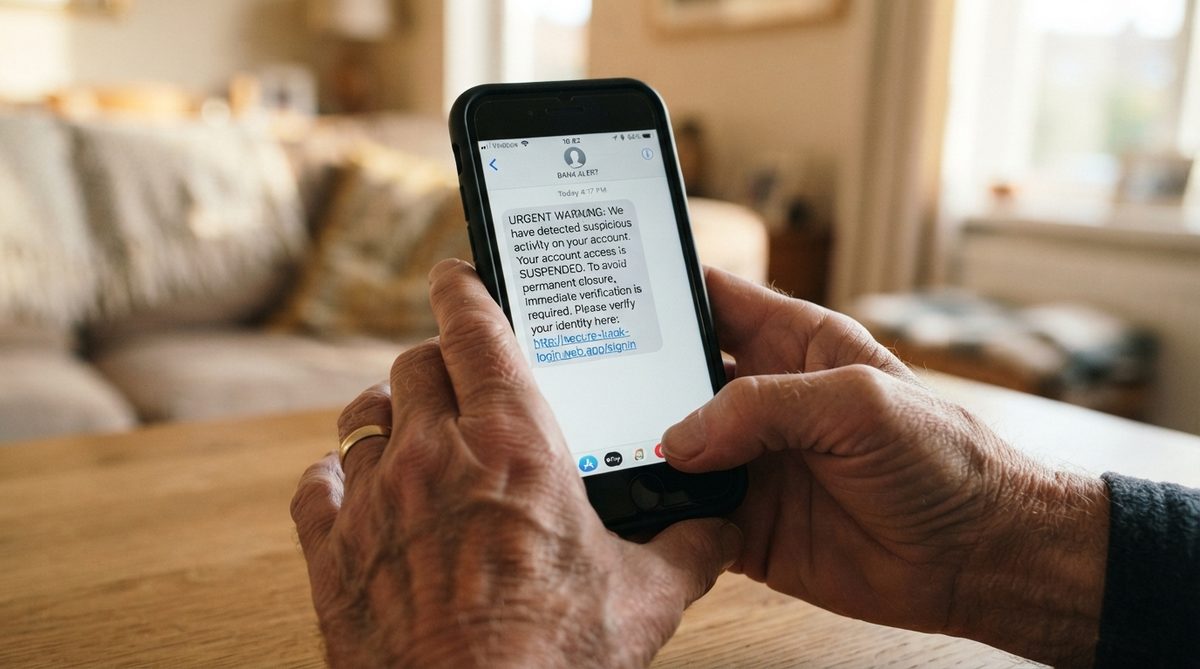
Your smartphone is where most scams now originate. According to FTC data, phone calls and text messages are the top two contact methods for fraud targeting older adults.
- Enable built-in spam filtering: Both iPhone (Settings → Phone → Silence Unknown Callers) and Android (Phone app → Settings → Caller ID & Spam) have native tools that block likely scam calls
- Never click links in unexpected text messages — even if they appear to come from your bank, the USPS, or a delivery service. Navigate to the company’s app or website directly instead
- Set up a SIM PIN with your carrier to prevent SIM-swapping attacks, where criminals transfer your phone number to their device to intercept verification codes
Strengthen Your Financial Accounts
- Enable two-factor authentication (2FA) on every financial account. Prefer an authenticator app (like Google Authenticator or Authy) over SMS text codes when available
- Set up transaction alerts for any purchase or transfer over a threshold you choose — $50, $100, whatever makes sense for your spending patterns
- Place a credit freeze with all three major bureaus (Equifax, Experian, TransUnion). This is free, takes minutes, and prevents anyone from opening new accounts in your name. You can temporarily lift the freeze when you need to apply for credit
Protecting your financial accounts from fraud is one piece of a larger puzzle. If you’re also thinking about how to safeguard your nest egg from other risks, the analysis in 5 Biggest Financial Concerns for Retirees and How to Fix Them is worth your time.
Protect Your Home Network
If you use smart home devices, a Wi-Fi connected security system, or do online banking from home, your router is the front door to your digital life.
- Change your router’s default administrator password (the one used to access router settings, not your Wi-Fi password — though change that too if it’s still the factory default)
- Enable WPA3 encryption if your router supports it; WPA2 at minimum
- Keep your router’s firmware updated — many modern routers can do this automatically if you enable the setting
What to Do If You’ve Already Been Targeted
If you suspect you’ve fallen victim to a scam — or even if you’ve simply engaged with a suspicious contact — act quickly. Speed matters for fund recovery.
- Contact your bank or credit card company immediately. Many institutions have dedicated fraud departments available 24/7. Wire transfers can sometimes be recalled within the first 24-48 hours
- File a report with the FBI’s IC3 at ic3.gov. This isn’t just for statistics — it feeds active investigations and has led to significant fund recoveries in larger cases
- Report to the FTC at ReportFraud.ftc.gov
- Contact your local Adult Protective Services if the scam involved ongoing exploitation or if you’re concerned about a vulnerable family member
- Don’t feel ashamed. These are professional criminals who do this full-time. Reporting helps protect the next potential victim
The Bigger Picture: Technology as Shield, Not Just Threat
I want to close with perspective that often gets lost in discussions about financial scams targeting older adults. Technology itself isn’t the enemy. The same smartphone that scammers try to exploit is also the device that lets you video call grandchildren across the country, manage your health with medication reminder apps, monitor your home security remotely, and access telehealth services.
The goal isn’t to retreat from technology — it’s to use it with the same street smarts you’d apply walking through an unfamiliar neighborhood. Lock your doors. Know who you’re talking to. Trust your instincts when something feels off.
In my professional experience, the older adults who are most resilient against scams aren’t necessarily the most technically skilled. They’re the ones who’ve internalized one principle: legitimate organizations never create artificial urgency. Your bank will not close your account in 30 minutes. The IRS will not arrest you today. Your grandson can wait while you verify the situation with his parents.
That pause — that moment of critical thinking before action — is worth more than any antivirus software on the market. And it costs nothing.
Stay skeptical, stay curious, and stay connected. The digital world has enormous benefits for Americans over 50. You just need to navigate it with your eyes open.
About Dr. Priya Sharma, PhD in Computer Science, CISSP
Dr. Priya Sharma is a cybersecurity expert with a PhD in Computer Science and a Certified Information Systems Security Professional (CISSP) credential. She has spent 14 years researching digital privacy, online fraud, and data protection — with a particular focus on the risks facing older internet users. At Daily Trends Now, Dr. Sharma writes about online scams, password security, smartphone privacy, and the practical steps readers can take to stay safe in an increasingly connected world.