

A Surprising Finding Is Rewriting the Narrative on Screens and Aging
For years, headlines warned that too much screen time was rotting brains across every age group. Then came a finding that upended the conventional wisdom for anyone over 50: a peer-reviewed study published in the Journal of the American Geriatrics Society in 2024 found that regular smartphone use among adults aged 50 and older was associated with a lower risk of cognitive decline over an eight-year follow-up period. The reduction was not trivial—participants who used smartphones at least several times a week showed roughly a 30% lower odds of developing cognitive impairment compared to non-users, even after researchers controlled for education, income, and baseline health.
That statistic deserves a double take. It suggests that the device in your pocket—often blamed for distraction and anxiety—may actually help preserve memory, processing speed, and executive function as you age. But the relationship is far from simple. Other research, including a 2023 study from the University of Galway, warns that compulsive smartphone use raises the risk of depression in older adults. The difference between benefit and harm appears to come down to how you use the phone, not merely whether you use it.
This deep-dive analysis unpacks the latest science on smartphone use and cognitive decline after 50, explains the mechanisms researchers believe are at work, identifies the usage patterns that help versus hurt, and delivers a concrete action plan for leveraging technology to keep your mind sharp—without falling into the traps that lead to anxiety, isolation, or fraud.
What the Research Actually Shows
The Headline Study: Smartphone Use and Cognitive Protection
The study drawing the most attention tracked over 6,000 participants in the Health and Retirement Study (HRS), a nationally representative longitudinal survey funded by the National Institute on Aging. Researchers measured cognitive function using standardized tests of memory recall and mental status at multiple intervals between 2012 and 2020. After adjusting for confounders—age, sex, race, education, depressive symptoms, chronic conditions, and physical activity—regular smartphone users had significantly lower odds of transitioning from normal cognition to mild cognitive impairment.
Importantly, the protective association was strongest among those who used smartphones for cognitively stimulating activities: reading news, navigating maps, managing finances, playing word or strategy games, and communicating via text or video. Passive scrolling through social media feeds showed a weaker—and in some models, statistically insignificant—association with cognitive benefit.
The Counterweight: When Smartphone Use Backfires
A separate 2023 study published in International Psychogeriatrics surveyed over 3,000 adults aged 50-plus and found that those scoring high on a “compulsive smartphone use” scale—checking the phone dozens of times per hour, feeling anxious when separated from it, losing sleep to scroll—had a 35% higher prevalence of moderate-to-severe depressive symptoms. The researchers emphasized that the problem was not the smartphone itself but the behavioral pattern of compulsive checking and comparison.
Taken together, these studies paint a nuanced picture: intentional, varied smartphone use appears cognitively protective, while compulsive, passive use can undermine mental health. The critical task for anyone over 50 is learning to land on the right side of that divide.

Why Smartphones May Protect the Aging Brain
Researchers have proposed several overlapping mechanisms to explain the cognitive benefits observed in regular smartphone users over 50. None of these theories are fully proven yet, but each has supporting evidence from neuroscience and gerontology.
Cognitive Reserve and Novel Stimulation
The concept of “cognitive reserve” holds that brains with more neural connections can better compensate for age-related damage. Learning to use new apps, navigating unfamiliar digital interfaces, and problem-solving when technology does not work as expected all qualify as novel cognitive challenges—the kind of activity most consistently linked to building reserve. According to AARP’s technology research division, 73% of adults over 50 now own a smartphone, and the fastest-growing segment of new adopters is aged 70 to 80—meaning millions of older Americans are encountering these novel challenges for the first time.
Social Connection and Reduced Isolation
Loneliness is now recognized as a major risk factor for dementia, with the National Academies of Sciences estimating that social isolation increases dementia risk by approximately 50%. Smartphones enable video calls, group texts, and social media interactions that can partially offset the physical isolation many older adults experience—especially those living alone or in rural areas. The key word is “partially”: digital connection supplements but does not fully replace in-person interaction.
Health Management and Physical Activity
Smartphones serve as platforms for medication reminders, step counters, telehealth appointments, and nutrition tracking. Each of these functions supports physical health, which is itself a powerful predictor of cognitive longevity. A 2024 Consumer Reports survey found that 41% of adults over 60 who use health apps reported being more consistent with prescribed medications than before adopting the technology.
Intentional vs. Compulsive Use: A Side-by-Side Comparison
Understanding the difference between beneficial and harmful smartphone habits is essential. The following table contrasts the two patterns based on the research literature.
| Dimension | Intentional Use (Linked to Cognitive Benefit) | Compulsive Use (Linked to Depression Risk) |
|---|---|---|
| Daily Screen Time | 1–3 hours of purposeful activity | 4+ hours, often without a specific goal |
| Primary Activities | Reading, puzzles, video calls, navigation, health apps | Endless social media scrolling, doomscrolling news |
| Notification Habits | Notifications silenced or batched; phone checked on a schedule | All notifications on; phone checked 40–80+ times/day |
| Emotional Response | Feels in control; phone is a tool | Anxiety when phone is out of reach; guilt after long sessions |
| Sleep Impact | Phone placed outside bedroom or on Do Not Disturb by 9 PM | Phone used in bed; blue-light exposure disrupts sleep |
| Social Outcome | Strengthens existing relationships via calls and video chats | Replaces in-person interaction; increases social comparison |
| Cognitive Outcome (Research Association) | ~30% lower odds of cognitive impairment (HRS data) | ~35% higher prevalence of depressive symptoms (Int. Psychogeriatrics) |
The Best Cognitive Activities You Can Do on a Smartphone
Not every app is created equal when it comes to brain health. Research and expert consensus from organizations like AARP and the Alzheimer’s Association suggest that the most beneficial smartphone activities share a few traits: they require active engagement, introduce novelty, and ideally include a social or physical component.
Language and Word Games
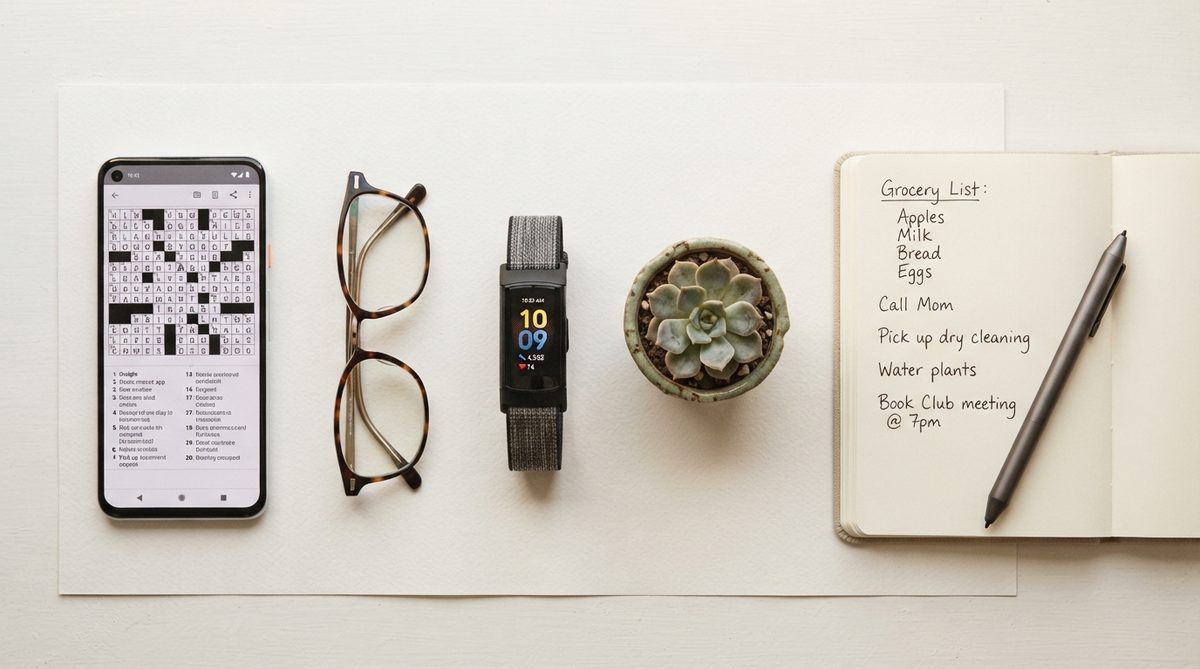
Apps like Wordle, crossword puzzles, and Scrabble-style games challenge verbal fluency and working memory. A 2023 meta-analysis in Neuropsychology Review found that word-based cognitive training produced small but reliable improvements in verbal recall among adults over 60.
Navigation and Map Use
Spatial navigation is one of the earliest cognitive abilities to decline in preclinical Alzheimer’s disease. Actively using map apps—zooming in, planning routes, estimating distances—engages the hippocampus, the brain region most vulnerable to age-related atrophy. Consider planning a walking route in a new neighborhood once a week rather than always relying on turn-by-turn voice directions.
Video Calling
Face-to-face video conversation requires real-time language processing, emotional recognition, and attentional focus. A 2022 study in The Gerontologist found that older adults who used video calling at least twice a week reported 20% lower loneliness scores than those who relied solely on voice calls.
Financial Management Apps
Tracking spending, reviewing account balances, and budgeting involve numerical reasoning and planning—executive functions seated in the prefrontal cortex. For those managing retirement income, this kind of active engagement also has practical value. If you are rethinking your retirement budget in light of rising costs, our guide on Inflation and Retirement Savings: A Practical Guide to Fighting Back offers concrete strategies.
Health and Fitness Tracking
Step-counter apps, medication reminders, and blood pressure logs keep you physically active and medically adherent—two of the strongest modifiable protections against cognitive decline. Pair a fitness tracker with your smartphone to set daily movement goals.
A Seven-Step Action Plan for Cognitive-Healthy Smartphone Use
Turning the research into daily practice requires structure. The following plan is designed specifically for adults 50 and over who want to maximize cognitive benefit while minimizing the risks of compulsive use and online fraud.
- Audit your current usage. Both iPhones (Screen Time) and Android phones (Digital Wellbeing) have built-in tools that show exactly how many hours you spend on your phone and which apps consume the most time. Check your report today and write down your baseline numbers.
- Set a daily time budget. Based on the research, aim for 1–3 hours of purposeful smartphone activity per day. Use your phone’s built-in app timer to set limits on social media apps—15 to 30 minutes total is a reasonable cap.
- Install at least two cognitively stimulating apps. Choose one word or strategy game and one health or finance app. Rotate in a new app every month to maintain the novelty factor that drives cognitive reserve building.
- Schedule video calls. Set a recurring weekly video call with a friend, sibling, or grandchild. Treat it like a doctor’s appointment—put it on the calendar and protect the time. The social connection is as important as the cognitive engagement.
- Silence non-essential notifications. Go into your phone’s notification settings and turn off alerts for everything except phone calls, text messages, and calendar reminders. This single change dramatically reduces compulsive checking behavior.
- Create a “phone curfew.” Place your phone on a charger outside the bedroom at least one hour before sleep. If you use your phone as an alarm clock, buy a $10 alarm clock instead—it is one of the highest-return investments in sleep quality you can make.
- Learn one new phone skill per month. Whether it is setting up two-factor authentication, learning to edit photos, or using voice commands to send texts, the process of learning itself is what strengthens neural pathways. AARP’s free technology how-to guides at aarp.org/technology are an excellent starting point.
The Safety Layer: Protecting Your Brain and Your Wallet
Any discussion of smartphone use for older adults is incomplete without addressing digital safety. The Federal Trade Commission reported that consumers aged 60 and over lost more than $1.9 billion to fraud in 2023, with a growing share of those losses originating from smartphone-based scams—fake text messages, phishing links, and fraudulent app downloads.
Essential Security Practices
Before ramping up your smartphone activity, lock down your device. Enable automatic software updates, which patch security vulnerabilities. Use a strong passcode—six digits minimum, or biometric unlock (fingerprint or face recognition). And never click a link in a text message from an unknown sender. The Cybersecurity & Infrastructure Security Agency (CISA) publishes regularly updated guides on mobile device security that are written in plain, accessible language.
For a comprehensive look at the most common scam tactics and how to defeat them, see our detailed walkthrough in Elder Fraud Is Surging: A Practical Guide to Fighting Back.
AI Assistants: Helpful but Handle with Care
Voice-activated AI assistants like Siri, Google Assistant, and Alexa can be genuinely useful—setting reminders, reading news aloud, and answering quick questions. However, avoid sharing sensitive personal information (Social Security numbers, bank account details, medical diagnoses) with any AI tool or chatbot. These systems store conversation data, and data breaches remain an ongoing risk across the technology industry.
What About Those “Senior-Friendly” Phones?
Several manufacturers now market simplified smartphones aimed at older adults, featuring larger text, louder speakers, and stripped-down interfaces. Models like the Jitterbug Smart4 (by Lively), the Consumer Cellular Iris Flip, and certain Samsung Galaxy models with “Easy Mode” enabled are popular choices.
These phones can be a good entry point for someone who has never used a smartphone. But from a cognitive-benefit standpoint, there is a trade-off: the more simplified the interface, the less novel cognitive challenge it provides. If your goal is both ease of use and brain stimulation, consider a mainstream smartphone (iPhone SE or Samsung Galaxy A-series, for example) with accessibility settings turned on—larger text, simplified home screen, and magnification gestures—rather than a device that permanently limits what you can do.
The Bigger Picture: Technology as Part of an Aging Strategy
Smartphone use does not exist in a vacuum. The cognitive benefits documented in the research are strongest when they complement—not replace—other pillars of healthy aging: physical exercise, social engagement, nutritious eating, quality sleep, and ongoing medical care. Think of your smartphone as one tool in a larger toolkit.
For those planning to age in their own homes, technology intersects with home safety in important ways—from smart medication dispensers to fall-detection wearables. Our resource on How to Make Your Home Safe for Aging in Place: A Step-by-Step Guide covers the physical modifications and smart-home integrations that support independent living.
The Bottom Line: Use It Well, Not Just More
The emerging research on smartphone use and cognitive decline after 50 carries a hopeful but conditional message. Regular, intentional use of a smartphone—for learning, communicating, navigating, and managing health—is associated with meaningful cognitive protection. But compulsive, passive scrolling carries real mental health risks.
The distinction is not about age. It is about agency. When you pick up your phone with a purpose, complete that purpose, and put the phone down, you are engaging your brain in ways that appear to build resilience against cognitive decline. When the phone picks you up—buzzing, pulling, and trapping you in an endless scroll—the effect can reverse.
The good news is that shifting from compulsive to intentional use does not require a technology degree. It requires a few setting changes, a short list of worthwhile apps, and the same discipline you bring to any other health habit. The seven-step plan above is a starting framework. Adapt it, experiment, and keep learning—because that process of learning is, ultimately, the point.
Frequently Asked Questions
Does smartphone use really lower the risk of cognitive decline after 50?
Research from the Health and Retirement Study found that regular, intentional smartphone use among adults 50 and older was associated with roughly 30% lower odds of cognitive impairment over eight years. However, the benefit is tied to cognitively stimulating activities—reading, puzzles, video calls, and navigation—not passive scrolling.
How many hours per day should older adults spend on a smartphone for cognitive benefit?
Based on current research, 1 to 3 hours of purposeful smartphone activity per day appears to be the beneficial range. Beyond that, especially if the time is spent passively on social media, the risk of depression and compulsive behavior increases significantly.
Are senior-friendly phones as good for brain health as regular smartphones?
Simplified phones are excellent for accessibility but may provide less cognitive stimulation because they reduce the novelty and complexity of the interface. A mainstream smartphone with accessibility settings enabled—larger text, simplified home screen—can offer both ease of use and greater cognitive challenge.
What is the biggest safety risk for older adults using smartphones more often?
Fraud is the leading smartphone-related safety risk for adults over 60. The FTC reported over $1.9 billion in losses for this age group in 2023, with many scams delivered via text messages and phishing links. Enabling automatic updates, using strong passcodes, and never clicking links from unknown senders are critical protective steps.