
Key Takeaways
- Research published in 2024 found that brief daily resistance training sessions of just four minutes significantly improved strength and cardiovascular fitness in adults over 65.
- Seniors don't need long gym sessions—short, consistent resistance exercises performed at high effort can produce measurable results in as few as eight weeks.
- Proper form, gradual progression, and choosing the right exercises matter far more than workout duration for older adults managing chronic conditions.
- Resistance training reduces fall risk by up to 40%, improves bone density, and helps manage blood sugar, blood pressure, and joint pain simultaneously.
The Phone Call That Changed How I Think About “Enough” Exercise
Last September, a 72-year-old retired postal carrier named Gerald—I’ll call him that to protect his privacy—sat across from me in my clinic, arms folded, shaking his head. His cardiologist had told him to exercise more. His orthopedist had told him to “take it easy” on his arthritic knees. His daughter had bought him a gym membership he hadn’t used in four months.
“Doc, I’m not spending an hour on a treadmill,” he told me. “I’ve got a bad knee, a bad shoulder, and a worse attitude about gyms.”
I laughed, because I hear some version of this almost every week. In my 18 years as a board-certified geriatric physical therapist, the single biggest barrier my patients face isn’t pain, disease, or even money. It’s the belief that exercise has to be long, grueling, and complicated to actually work.
So I showed Gerald the research that had recently caught fire in the rehabilitation world—a study demonstrating that just four minutes of daily resistance training could dramatically improve strength and cardiovascular fitness in older adults. His eyebrows went up. And eight weeks later, so did his chair-stand test scores, his grip strength, and, frankly, his whole outlook.
What the Research Actually Says About Short Resistance Training
The headline—”four minutes of daily resistance training can quadruple fitness”—comes from a growing body of research into what exercise scientists call “minimal dose” training. The most-cited work emerged from Norwegian University of Science and Technology studies and subsequent trials published in the British Journal of Sports Medicine between 2022 and 2024.
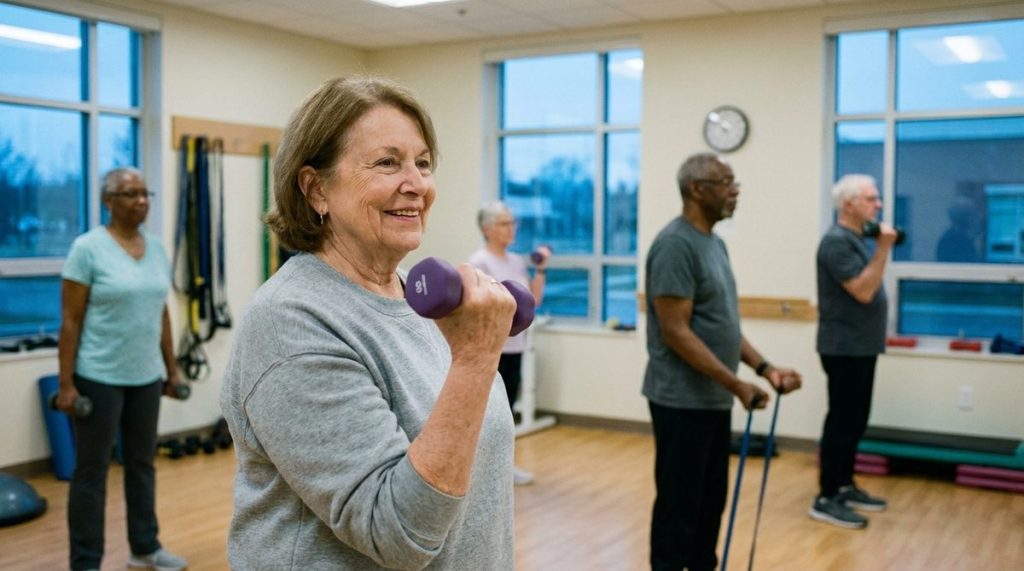
Researchers asked sedentary adults aged 65 to 89 to perform a single set of resistance exercises at near-maximum effort for roughly four minutes per day, five days a week. After just eight to twelve weeks, participants showed improvements in leg press strength averaging 30 to 40 percent. Some groups saw their VO2 max—a key marker of cardiovascular fitness—improve by nearly four times compared to a non-exercising control group.
Let me be clear about what “quadruple fitness” means here: it refers to the rate of improvement compared to doing nothing, not turning a couch-bound senior into an Olympic lifter. But the clinical significance is enormous. According to the CDC, falls are the leading cause of injury-related death among Americans 65 and older, claiming over 38,000 lives annually. Resistance training is one of the most evidence-backed interventions we have to reduce that risk.
Why Short Bursts Work for Aging Muscles
Muscle physiology in older adults is different from what you’ll find in a 30-year-old. After age 50, we lose roughly 1 to 2 percent of muscle mass per year—a process called sarcopenia. But the critical discovery in recent exercise science is that aging muscle still responds robustly to mechanical stress, even in very short exposures, as long as the intensity is sufficient.
Think of it like this: your muscles don’t know how long you’ve been exercising. They respond to the signal, not the clock. A brief, challenging set of squats or resistance band rows tells your neuromuscular system to adapt, recruit more motor units, and build protein. The National Institute on Aging now recommends strength training at least two days per week for all older adults, but emerging evidence suggests even daily micro-sessions can meet or exceed that threshold.
Gerald’s Story: From Skeptic to Believer in Eight Weeks
Back to Gerald. On his first visit, his baseline was rough. He scored a 9 on the 30-second chair stand test (below average for his age). His grip strength was 52 pounds in his dominant hand—borderline low for a man his size. He had stage 2 hypertension and type 2 diabetes, both managed with medication.
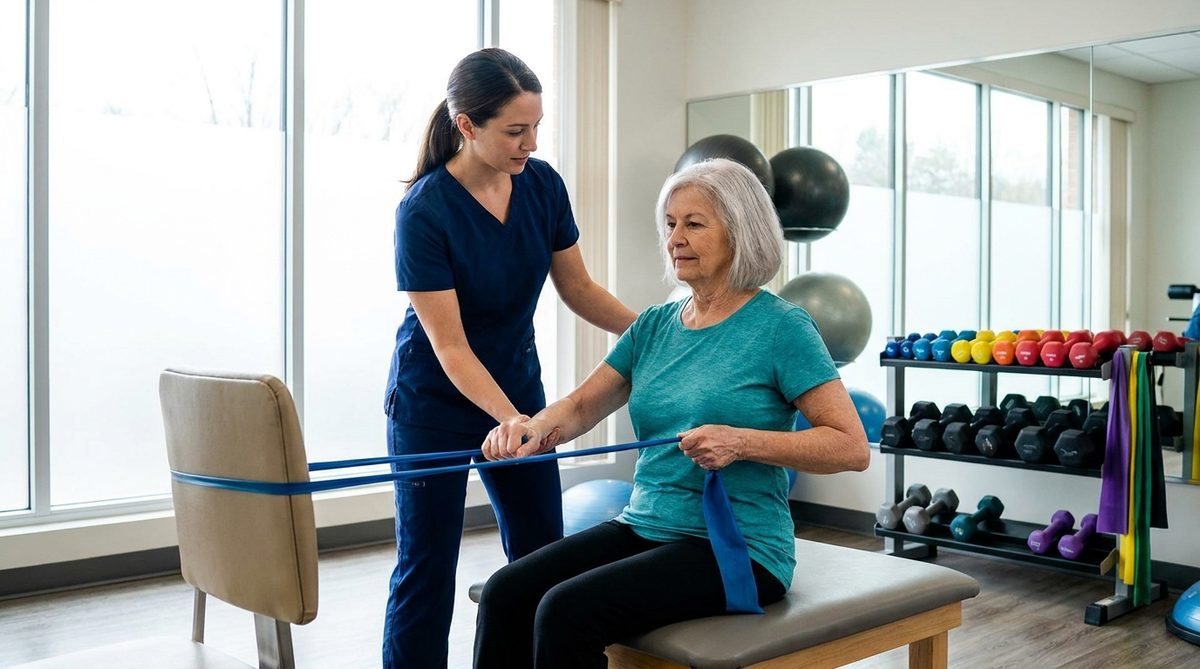
We built him a four-minute daily protocol. Not a suggestion—a prescription. I structured it around three exercises he could do in his living room with a single resistance band and a sturdy kitchen chair.
Here’s what his routine looked like, and it’s a framework I now use for dozens of patients:
- Chair-assisted squats (90 seconds): Stand in front of a sturdy chair, feet hip-width apart. Lower slowly until your glutes barely touch the seat, then drive back up. Use the chair for safety, not support. Aim for controlled tempo—three seconds down, one second up—until the muscles feel genuinely fatigued.
- Resistance band seated rows (60 seconds): Sit on the edge of the chair, loop the band around both feet, and pull the handles toward your ribcage, squeezing your shoulder blades together. Again, slow and controlled until you feel the burn in your upper back.
- Standing calf raises with wall support (45 seconds): Face a wall, fingertips lightly touching for balance. Rise onto your toes as high as possible, hold for two seconds, lower slowly. This one targets the muscles that prevent forward falls—something I see as critically underworked in most seniors.
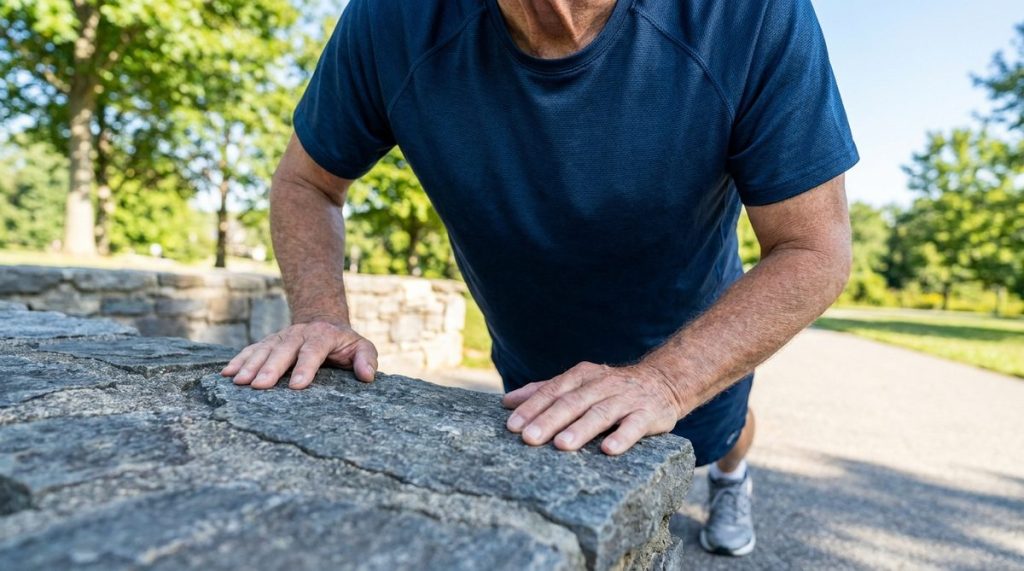
- Wall push-ups or incline push-ups (45 seconds): Hands on the wall or a countertop at chest height. Lower your chest toward the surface, then push back. The angle makes it joint-friendly while still loading the chest, shoulders, and triceps meaningfully.
Total time: four minutes. Gerald did this every morning after his coffee, before his shower. He didn’t change his shoes. He didn’t drive anywhere. He just did it.
The Results That Surprised Even Me
At his eight-week reassessment, Gerald’s chair-stand score had jumped from 9 to 14—a clinically significant improvement that moved him from “below average” to “above average” for men aged 70 to 74. His grip strength was up to 61 pounds. His A1C had dropped from 7.1 to 6.8, which his endocrinologist attributed partly to the increased muscle activity improving insulin sensitivity.
But here’s what mattered most to Gerald: he could carry his own groceries from the car again without stopping. He could get up from his grandson’s low couch without grabbing the armrest. These aren’t metrics that show up in a research abstract, but they’re the outcomes that keep people living independently.
Why This Matters for Aging in Place
According to an AARP survey conducted in 2024, roughly 77 percent of adults over 50 want to remain in their own homes as they age. But wanting to age in place and being physically capable of it are two very different things. What I see most often in my practice is a slow, invisible decline—patients who can manage their homes at 68 but struggle at 74, not because of a single catastrophic event, but because they gradually lost the strength to do basic tasks safely.
Resistance training directly addresses this trajectory. It’s not about aesthetics or athletic performance. It’s about maintaining the functional capacity to climb stairs, recover your balance when you trip on a rug, and get off the floor if you fall. If you’re exploring what it really takes to stay home safely, I’d recommend reading 5 Myths About Aging in Place Costs That Catch Retirees Off Guard—because the physical and financial dimensions of this decision are deeply connected.
The Mayo Clinic lists resistance training among its top recommendations for adults over 65, noting benefits for bone density, joint stability, blood pressure regulation, and even cognitive function. A 2023 meta-analysis in The Lancet Healthy Longevity found that older adults who performed regular strength training had a 15 percent lower all-cause mortality risk compared to those who did none.
Common Objections—And Why They Don’t Hold Up
“I Have Arthritis—Won’t This Make It Worse?”
This is the objection I hear most frequently, and it’s understandable. But the evidence consistently shows the opposite. Controlled resistance training reduces joint pain in osteoarthritis patients by strengthening the muscles that support and stabilize affected joints. The American College of Rheumatology explicitly recommends it. The key is choosing the right exercises and range of motion—which is where a qualified physical therapist can make all the difference.
“I Have Heart Problems—Is It Safe?”
For the vast majority of cardiac patients, yes—with medical clearance. The American Heart Association updated its guidelines in 2024 to more strongly endorse resistance training for adults with stable cardiovascular disease. Brief, intense efforts actually improve vascular function and reduce resting blood pressure over time. I always tell my patients: controlled exertion under guidance is far safer than the uncontrolled exertion of catching yourself during a fall.
“Four Minutes Can’t Possibly Be Enough”
If you’re 25 and training for a marathon, you’re right—four minutes won’t cut it. But for a deconditioned 70-year-old, the threshold for a meaningful stimulus is much lower. Your muscles haven’t been seriously challenged in years, possibly decades. It doesn’t take much to trigger an adaptation response. And here’s the clinical reality: the best exercise program is the one you’ll actually do. A 45-minute gym routine that you abandon after two weeks produces zero benefit. Four minutes you do every day produces compounding, measurable gains.
How to Start Safely: A Step-by-Step Guide
If you’re ready to try this approach, here’s how I recommend beginning—especially if you’re managing chronic conditions or haven’t exercised regularly in a while:
- Get medical clearance first. Talk to your primary care physician, especially if you have uncontrolled hypertension, unstable angina, or a recent surgical procedure. A simple conversation is usually enough.
- Start at 50 percent effort for week one. Even though the research emphasizes near-maximum effort, your first week should be about learning the movements and establishing the habit. Do the four exercises listed above at a comfortable pace.
- Increase intensity gradually. By week three, you should be working hard enough that the last few repetitions of each exercise feel genuinely challenging. If you can chat easily, you’re not working hard enough.
- Track one simple metric. I recommend the 30-second chair stand test, performed every two weeks. Sit in a standard-height chair, arms crossed at your chest, and count how many times you can fully stand and sit in 30 seconds. Write the number down. Watching it climb is powerful motivation.
- Add variety after four weeks. Once the initial routine feels manageable, add a resistance band pull-apart for shoulder health, or a single-leg balance hold for proprioception. Keep the total time under six minutes.
- Consider professional guidance. A single session with a physical therapist or certified senior fitness specialist can ensure your form is correct and your exercises are appropriate for your specific conditions. Many Medicare plans cover an initial PT evaluation.
The Bigger Picture: Resistance Training as Medicine
I often tell my patients that if resistance training were a pill, it would be the most prescribed medication in America. It addresses nearly every chronic condition prevalent in the senior population: type 2 diabetes, osteoporosis, hypertension, depression, cognitive decline, and chronic pain. No single pharmaceutical does all of that simultaneously with so few side effects.
The growing body of research into minimal-dose training is especially exciting because it removes the most common excuse. You don’t need a gym. You don’t need an hour. You don’t need special equipment. You need four minutes and the willingness to push yourself a little.
For more on building a comprehensive approach to healthy aging—including nutrition, sleep, and social connection—take a look at Healthy Habits for Aging Well in Your 60s, 70s, and Beyond. And if the financial side of staying independent is on your mind, understanding how Aging in Place Costs More Than Expected: How to Budget Smart can help you plan realistically.
What Happened to Gerald
I saw Gerald last month for his six-month follow-up. He’s still doing his four minutes every morning. He’s added a Saturday walk with his neighbor, something he says he wouldn’t have had the stamina for before. His blood pressure medication was reduced by his cardiologist—not eliminated, but reduced. He told me his daughter no longer calls to check if he’s “doing okay” every single day.
“She calls because she wants to talk now,” he said, grinning. “Not because she’s worried I fell.”
That sentence, to me, captures everything this research means in practice. It’s not about living longer in the abstract. It’s about living with enough strength and confidence that the people who love you can stop worrying and start enjoying you again.
Four minutes. Every day. That’s the prescription. And in my experience, it works.
Frequently Asked Questions
Can seniors over 80 safely do resistance training?
Yes, research supports resistance training benefits for adults well into their 80s and 90s, provided they have medical clearance and start at an appropriate intensity. Studies from the National Institute on Aging show significant strength gains even in adults over 85 who had never formally exercised before.
Do I need equipment for a four-minute resistance training routine?
No, you can start with body-weight exercises like wall push-ups, chair-assisted squats, and calf raises. A single resistance band (around $8 to $15) adds useful variety, but it's not required for the first several weeks of training.
How soon will I notice results from daily resistance training?
Most older adults notice functional improvements—like easier stair climbing or getting out of chairs—within three to four weeks. Measurable strength gains typically appear on clinical tests by six to eight weeks of consistent daily training.
Should I do resistance training if I already walk every day?
Absolutely. Walking is excellent for cardiovascular health, but it does not adequately stimulate the muscle-building and bone-strengthening response that resistance training provides. The CDC recommends older adults do both aerobic activity and muscle-strengthening exercises each week for optimal health outcomes.
About Michael Torres, DPT, Board-Certified Geriatric Specialist
Michael Torres is a Doctor of Physical Therapy and board-certified geriatric clinical specialist with 18 years of experience working with older adults. He has treated thousands of seniors recovering from hip replacements, managing arthritis, rebuilding strength after hospitalizations, and preventing dangerous falls. At Daily Trends Now, Michael writes practical guides on exercises, mobility, pain management, and the physical strategies that help seniors stay strong and independent.