


Key Takeaways
- Americans over 60 reported $4.8 billion in fraud losses in 2024 alone, a 43% increase from 2023, with the real number likely far higher due to underreporting.
- The five most dangerous scam categories targeting older adults are tech support fraud, romance scams, government impersonation, investment schemes, and grandparent scams — each exploiting specific psychological triggers.
- Simple, free defensive tools like call-screening apps, two-factor authentication, and credit freezes can block the vast majority of scam attempts before they succeed.
- Shame and embarrassment cause an estimated 75% of elder fraud to go unreported, which is exactly what scammers count on to keep operating.
The $4.8 Billion Number That Should Alarm Every American Family
Here’s a statistic that stopped me cold when I first pulled the data: Americans over 60 reported losing $4.8 billion to fraud and online scams in 2024, according to the FBI’s Internet Crime Complaint Center. That’s a 43% jump from 2023’s already staggering $3.4 billion. And the most disturbing part? Researchers at the AARP estimate that only about one in four victims ever reports the crime.
Do the math on that underreporting rate and you’re looking at potential actual losses approaching $20 billion in a single year. That’s not a typo. That’s a crisis.
In my 12 years covering consumer technology, I’ve watched scam tactics evolve from clumsy Nigerian prince emails to AI-generated voice clones that perfectly mimic a grandchild’s voice. The sophistication has leaped forward. But here’s what I also know from reporting hundreds of these stories: the defenses have gotten better too. The problem is that most people over 50 haven’t been shown how to use them.
This article is my attempt to change that — not with vague warnings, but with a specific, evidence-based breakdown of the biggest financial scams targeting older adults and the concrete tools that stop them.
Why Older Adults Are the Primary Target — And It’s Not What You Think
Let’s dispense with a harmful myth right away: scammers don’t target older adults because they think seniors are gullible or technologically incompetent. They target older adults because that’s where the money is. Americans over 60 control roughly 70% of all U.S. household wealth, according to Federal Reserve data. A successful scam against a 68-year-old retiree with a paid-off house and a 401(k) yields far more than targeting a 30-year-old with student debt.
There are also structural vulnerabilities that have nothing to do with intelligence. Older adults are more likely to answer phone calls from unknown numbers — a habit formed in decades when that was simply polite. They’re more likely to trust authority figures like “bank managers” or “federal agents.” And many live alone, which means there’s no one sitting next to them to say, “Wait, that sounds suspicious.” As we’ve covered in our piece on aging myths debunked, the assumption that cognitive decline drives scam vulnerability is largely wrong. Isolation and trust are far bigger factors.
Scammers know all of this. They study it. And they build their scripts around it with disturbing precision.
The Five Most Dangerous Scams Targeting Adults Over 50 Right Now
Based on FBI IC3 reports, FTC complaint data, and my own reporting, these are the five scam categories doing the most financial damage to older Americans in 2025 and heading into 2026. I’m ordering them by total dollar losses, not just frequency.
1. Investment and Cryptocurrency Fraud
This is the single largest loss category, and it’s not close. The FBI reported $3.9 billion in investment-related fraud losses across all age groups in 2024, with adults over 60 accounting for a disproportionate share. The typical scheme involves a social media contact or dating app connection who gradually steers conversation toward a “guaranteed” investment opportunity, often in cryptocurrency.
What makes these so devastating is the long con. Victims are often “allowed” to make small withdrawals early on — real money coming back into their accounts — which builds trust. By the time the big deposit goes in, the platform is fake, the advisor is fake, and the money vanishes into a maze of crypto wallets.
The FTC’s consumer advice portal has documented a sharp rise in these schemes, particularly those using AI-generated video testimonials from people who appear to be real investors. I recently reviewed one such fake platform for an investigation, and I’ll admit — even with 12 years of experience spotting fraudulent tech, the production quality gave me a moment of pause.
2. Tech Support Scams
A pop-up appears on your screen: “YOUR COMPUTER HAS BEEN COMPROMISED. CALL THIS NUMBER IMMEDIATELY.” Or your phone rings, and a caller claims to be from Microsoft, Apple, or your internet provider. According to the FTC, tech support scams generated over 100,000 complaints in 2024, with a median individual loss of $1,000 among adults 60 and older — though many victims lost far more.
The mechanic is simple. The scammer gains remote access to your computer (you download a tool at their instruction), then “discovers” problems that require payment. Or, increasingly, they convince you to move money from your bank to a “safe” account — which is actually theirs. What I see most often in the cases I review is that the victim knew something felt wrong during the call but felt pressured by the urgency the scammer manufactured.
3. Government Impersonation Scams
These criminals pretend to be from the IRS, Social Security Administration, Medicare, or law enforcement. They tell you there’s a warrant for your arrest, your Social Security number has been “suspended,” or you owe a tax debt that must be paid immediately via gift cards or wire transfer. The FTC documented $789 million lost to impersonation scams in 2024 — and government impersonators were the most common type.
A key red flag that I always tell my readers: no real government agency will ever call you demanding immediate payment by gift card, wire transfer, or cryptocurrency. Not the IRS. Not the SSA. Not the FBI. Period. If you receive such a call, hang up and contact the agency directly through the number listed on their official website.

4. Romance and Companion Scams
The emotional toll here often exceeds the financial damage, though the financial damage is severe — $1.3 billion reported to the FTC in 2024 across all ages, with adults over 60 among the hardest hit. These scams exploit loneliness, which is a genuine public health crisis among older Americans. The AARP’s 2024 survey found that 34% of adults over 65 report feeling lonely regularly.
Modern romance scams aren’t just on dating apps. They start on Facebook, Instagram, Words With Friends, even church group forums. The scammer builds a relationship over weeks or months, then introduces a financial crisis — a medical emergency, a stuck shipment, a temporary cash flow problem. The requests start small and escalate. Victims often describe the shame they feel afterward as worse than the money lost, which is exactly why so many never report it.
If someone you’ve never met in person asks you for money — no matter how strong the connection feels — that is the single most reliable scam indicator that exists. As we’ve explored in our analysis of online scam myths costing older adults billions, many victims hesitate to speak up because they believe falling for a scam means they did something wrong. They didn’t. Professional criminals did something wrong to them.
5. The “Grandparent” and Family Emergency Scam
This one is particularly cruel. You receive a frantic phone call: “Grandma, I’m in trouble — I’ve been arrested / I’m in the hospital / I’m stranded in a foreign country. Please send money and don’t tell Mom and Dad.” In 2024, these scams surged thanks to AI voice-cloning technology. A scammer needs only a few seconds of someone’s voice — easily pulled from a social media video — to generate a convincing clone.
The FBI’s IC3 issued a specific advisory about AI-enhanced family emergency scams in early 2025, noting that victims reported the voice sounded “exactly like” their grandchild. The defense here is deceptively simple: hang up and call the family member directly at their known number. Every single time. Even if the voice sounds perfect.
The Psychological Playbook: How Every Scam Operates
After covering hundreds of scam cases, I can tell you that every successful scam, regardless of type, relies on the same three psychological levers:
- Urgency: You must act NOW or face arrest, lose your money, miss the investment window, or let your grandchild suffer. This manufactured panic suppresses your critical thinking.
- Authority: The scammer poses as someone you’d normally trust — a federal agent, a tech company employee, a bank officer, a romantic partner. This exploits your natural respect for legitimate institutions.
- Isolation: “Don’t tell anyone about this call.” “Keep this between us.” “Your family wouldn’t understand.” Every scammer tries to cut you off from the people who would talk you out of it.
Recognizing these three patterns is the single most powerful defense you can build. When any communication — phone, email, text, or social media message — combines urgency, authority, and a request for secrecy, you are almost certainly looking at a scam. Full stop.
Your Concrete Defense Toolkit: Technology That Fights Back
Here’s where I want to shift from diagnosis to treatment. These are specific, actionable defenses — most of them free — that dramatically reduce your exposure to financial scams targeting older adults.
Lock Down Your Phone
- Enable built-in call screening. Both iPhone (Silence Unknown Callers) and Android (Google’s Call Screen) can filter robocalls before they reach you. On iPhone, go to Settings → Phone → Silence Unknown Callers. On most Android phones, open the Phone app → Settings → Caller ID & Spam.
- Register with the National Do Not Call Registry at donotcall.gov. It won’t stop criminals, but it reduces legitimate telemarketing volume, making scam calls easier to spot.
- Never trust caller ID alone. Spoofing technology lets scammers display any number they want, including your bank’s real number. The Cybersecurity and Infrastructure Security Agency (CISA) warns that caller ID spoofing is now trivially easy for criminals.
Harden Your Accounts
- Turn on two-factor authentication (2FA) on every financial account, your email, and your social media profiles. This means even if someone steals your password, they can’t get in without a second code sent to your phone. Most banks now offer this in their app settings.
- Freeze your credit at all three bureaus — Equifax, Experian, and TransUnion. It’s free, it takes about 10 minutes per bureau, and it prevents anyone from opening new accounts in your name. You can temporarily lift the freeze when you legitimately need credit.
- Use a password manager. Consumer Reports recommends free or low-cost options like Bitwarden, which generates and stores unique passwords for every account. Reusing passwords across sites is one of the most common vulnerabilities I see among scam victims.
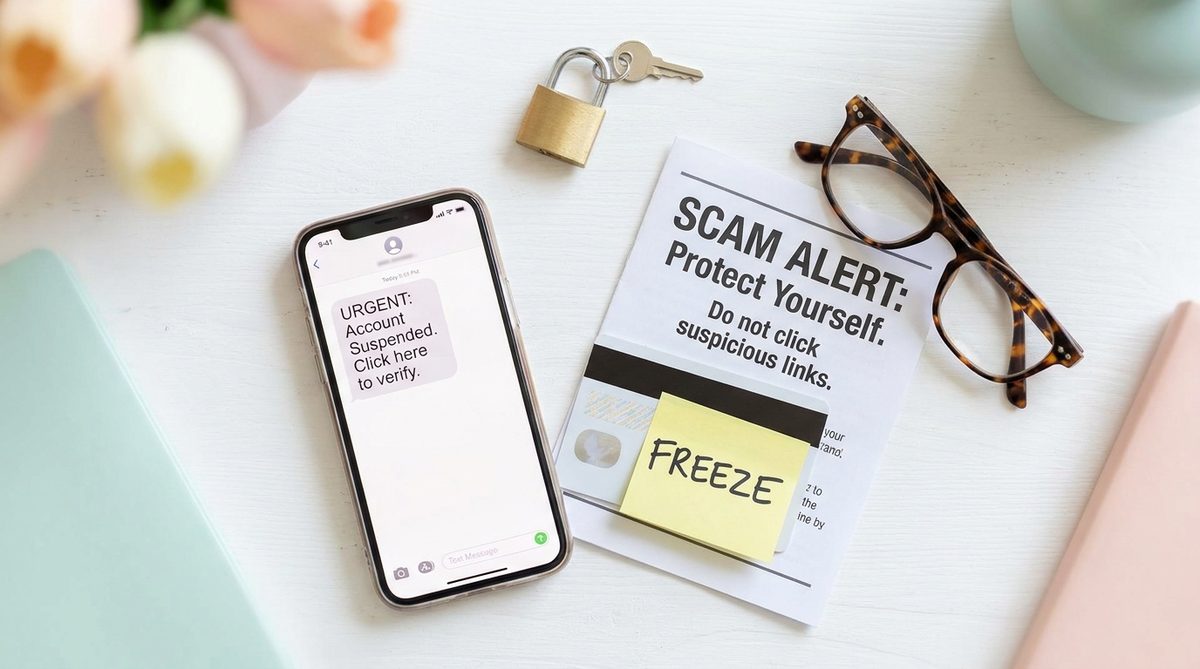
Build a Human Safety Net
Technology alone isn’t enough. The most effective scam defense is having someone you trust to consult before making any financial decision over $500 that was initiated by someone else contacting you.
- Designate a “scam check” partner — a family member, friend, or financial advisor you agree to call before sending money or sharing account information with anyone who contacts you first.
- Set up bank alerts. Most banks let you receive text or email notifications for any transaction over a threshold you choose. Setting this to $100 means you’ll catch unauthorized activity almost instantly.
- Talk about scams openly. The scammer’s greatest ally is shame-driven silence. Families who discuss scam attempts regularly — without judgment — create an environment where a potential victim feels safe saying, “I got a weird call today. Can you look at this with me?”
What To Do If You’ve Already Been Targeted
If you suspect you’ve been scammed or are currently in the middle of a suspicious interaction, take these steps immediately:
- Stop all communication with the suspected scammer. Block their number, email, and social media profiles.
- Contact your bank or credit card company immediately if you’ve shared financial information or sent money. Many institutions have fraud recovery teams that can freeze transactions within hours.
- Report the scam to the FTC at ReportFraud.ftc.gov and to the FBI’s IC3 at ic3.gov. These reports feed directly into federal investigations. Also contact your state attorney general’s office.
- Tell someone you trust. This is the hardest step for many people, and it’s the most important one. Remember: you are the victim of a crime. Professional criminals who do this for a living targeted you. There is no shame in that.
For those concerned about how scam losses compound existing financial pressures in retirement, our guide on how inflation is cutting into retirement savings in 2026 provides additional context on protecting your financial foundation.
The Bigger Picture: Why Digital Literacy Is a Financial Survival Skill
The AARP’s 2024 Technology Trends report found that tech adoption among adults over 50 has surged to record levels — 93% now own a smartphone, and 72% use social media regularly. That’s tremendous progress. But adoption without education creates a dangerous gap, and scammers are flooding into that gap.
What I’ve learned after more than a decade in this field is that scam prevention isn’t about avoiding technology. It’s about using technology with the same street smarts you’d apply walking through an unfamiliar neighborhood at night. You don’t stop walking. You stay alert, you keep your valuables close, and you don’t follow strangers down dark alleys.
The digital world works the same way. The tools to stay safe exist. They’re accessible. Many of them are free. But someone has to show you where they are and how to use them — and that’s a responsibility I believe falls on journalists, tech companies, financial institutions, and families alike.
Older adults losing billions to scams isn’t an inevitable consequence of aging. It’s a solvable problem. And solving it starts with replacing fear and shame with knowledge and preparation.
If this article helps even one person pause before clicking that link, hang up on that fake agent, or call their daughter before wiring money to a stranger — then it’s done its job.
About Alex Rivera, 12+ Years in Consumer Tech Reporting
Alex Rivera is a senior technology journalist with over 12 years of experience making technology accessible to everyday readers. He has covered consumer electronics, smartphones, smart home devices, streaming platforms, and digital privacy for major publications. At Daily Trends Now, Alex focuses on the tech that matters most to American adults — from choosing the right phone plan to protecting your data online. His reviews and guides cut through the jargon to help readers make confident technology decisions.