

Key Takeaways
- The average cost of five essential home modifications for aging in place totals $8,000–$19,000, compared to $64,200 per year for assisted living.
- Grab bars, the simplest modification, reduce bathroom fall injuries by up to 26% according to CDC data, yet only 8% of U.S. homes currently have them installed.
- Stairlift and walk-in shower conversions deliver the highest independence ROI, often delaying or eliminating the need for residential care by 5–10 years.
- Federally funded programs like Medicaid HCBS waivers and local Area Agency on Aging grants can cover 50–100% of modification costs for qualifying homeowners.
A $300 Grab Bar vs. a $64,000-a-Year Facility: The Math That Changes Everything
Here’s a statistic that still surprises people when I share it at consultations: according to the National Council on Aging, falls are the leading cause of injury-related death among Americans aged 65 and older — and one in four older adults falls each year. Yet fewer than 8% of the 140 million housing units in the United States have even basic accessibility features like grab bars, zero-step entries, or wider doorways.
Meanwhile, the median annual cost of an assisted living facility hit $64,200 in 2024, according to Genworth’s Cost of Care Survey. A private room in a nursing home? That’s $116,800. Compare that to the $8,000–$19,000 it typically costs to make five core home modifications for aging in place, and the financial case practically makes itself.
In my 14 years as a Certified Aging-in-Place Specialist, I’ve walked through over 2,000 homes with clients who assumed they’d eventually “have to move.” What I see most often is that targeted, well-planned modifications let people stay in the homes they love — safely — for years or even decades longer than they expected. This article breaks down exactly which modifications matter most, what they actually cost in 2025, and how to fund them without draining retirement savings.
Why “Aging in Place” Isn’t Just a Buzzword — It’s a Financial Strategy
The phrase “aging in place” gets tossed around so casually that it’s lost some weight. But let me reframe it: aging in place is a financial decision worth six figures. Every year you delay or avoid moving to an assisted living community, you keep roughly $5,350 per month in your pocket.
A 2024 AARP survey found that 77% of adults aged 50 and older want to remain in their current home as they age. The desire is overwhelming. The preparation, however, is not. Only 46% of those same respondents had taken any concrete steps to make their homes safer or more accessible.
That gap between intention and action is where injuries happen. And injuries are where the real costs pile up. A single hip fracture from a fall costs an average of $35,000–$40,000 in medical bills, and roughly 20% of hip fracture patients end up in a nursing facility within a year. If you’re weighing whether a $4,500 walk-in shower conversion is “worth it,” consider that it might prevent a $40,000 hospital stay and a permanent change in living situation.
For a broader look at how daily habits intersect with safety and longevity, I’d recommend reading 7 Healthy Aging Habits That Actually Work After 60 — the overlap between health maintenance and home safety is more significant than most people realize.
The Five Essential Home Modifications — And What They Really Cost in 2025
Not all modifications are equal. Some deliver outsized safety returns for minimal investment. Others are major construction projects. I’ve organized the five most impactful modifications by frequency of recommendation in my practice, then broken down what homeowners should expect to pay in 2025 dollars.
1. Grab Bars and Handrails
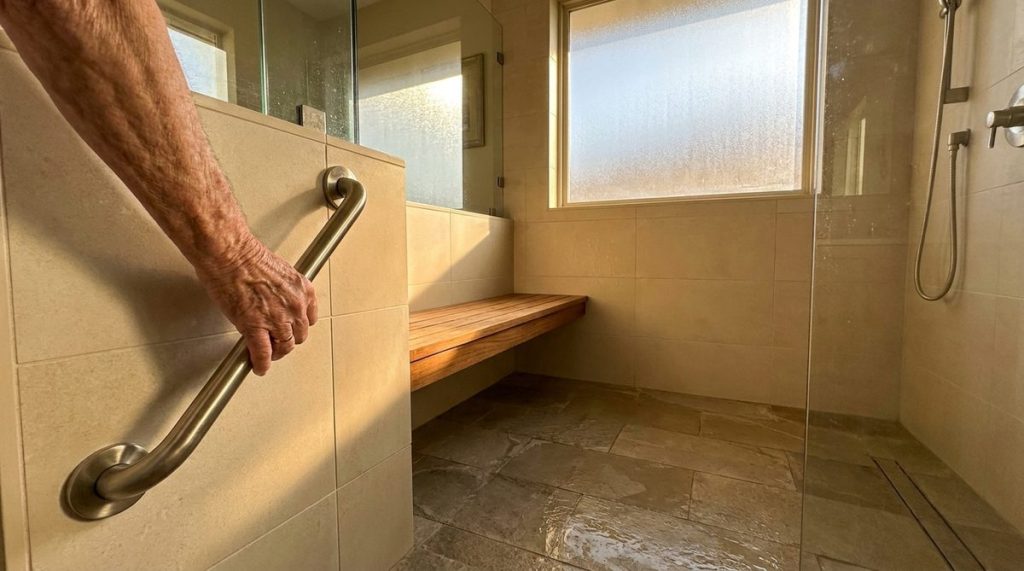
This is the single most cost-effective aging-in-place modification you can make, and it’s the one I recommend in virtually every home assessment. The CDC’s STEADI initiative data shows that properly installed grab bars in bathrooms reduce fall-related injuries by up to 26%.
Professional installation of a stainless steel or chrome grab bar costs $100–$300 per bar, including hardware rated for 250+ pounds of force. Most bathrooms need three to four bars — beside the toilet, inside the shower or tub, and at the shower entry. Total bathroom grab bar cost: $400–$1,200.
I often tell my clients that if they do nothing else from my assessment, they should install grab bars. The return on investment is extraordinary: a few hundred dollars to prevent an injury that could cost tens of thousands and change the trajectory of their independence.
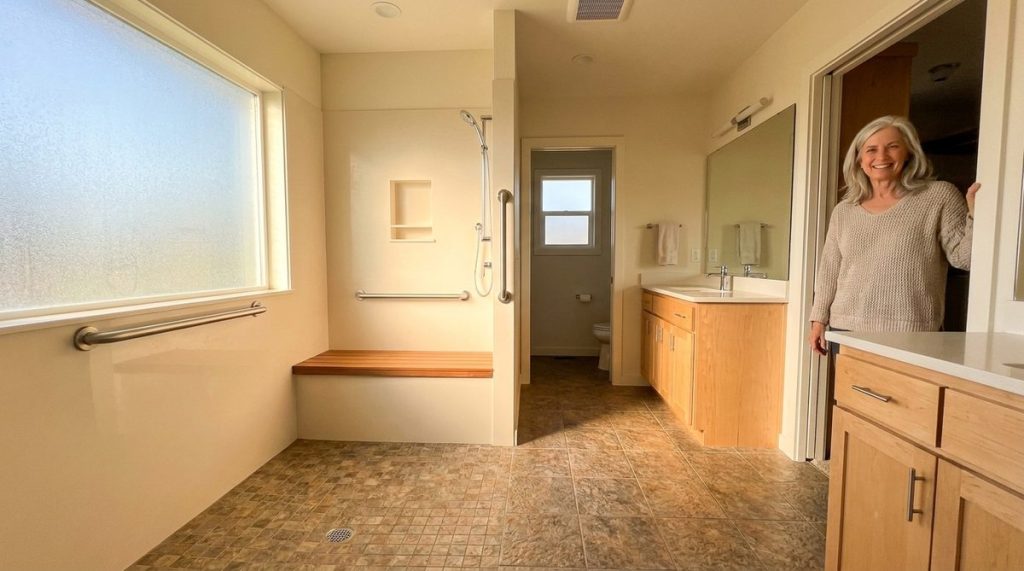
2. Walk-In Shower Conversion
Stepping over a standard bathtub rim — typically 14 to 16 inches high — is one of the most dangerous daily activities for adults over 65. A walk-in shower with a zero-threshold or low-threshold entry (under 1 inch) eliminates that risk almost entirely.
Full tub-to-shower conversions in 2025 run between $3,500 and $8,000, depending on tile selection, plumbing reconfiguration, and whether you add features like a built-in bench, handheld showerhead, or anti-scald valve. Prefabricated walk-in shower kits from retailers like Home Depot and Lowe’s start around $2,500 installed, but custom tile work pushes the price toward the higher end.
3. Stairlifts
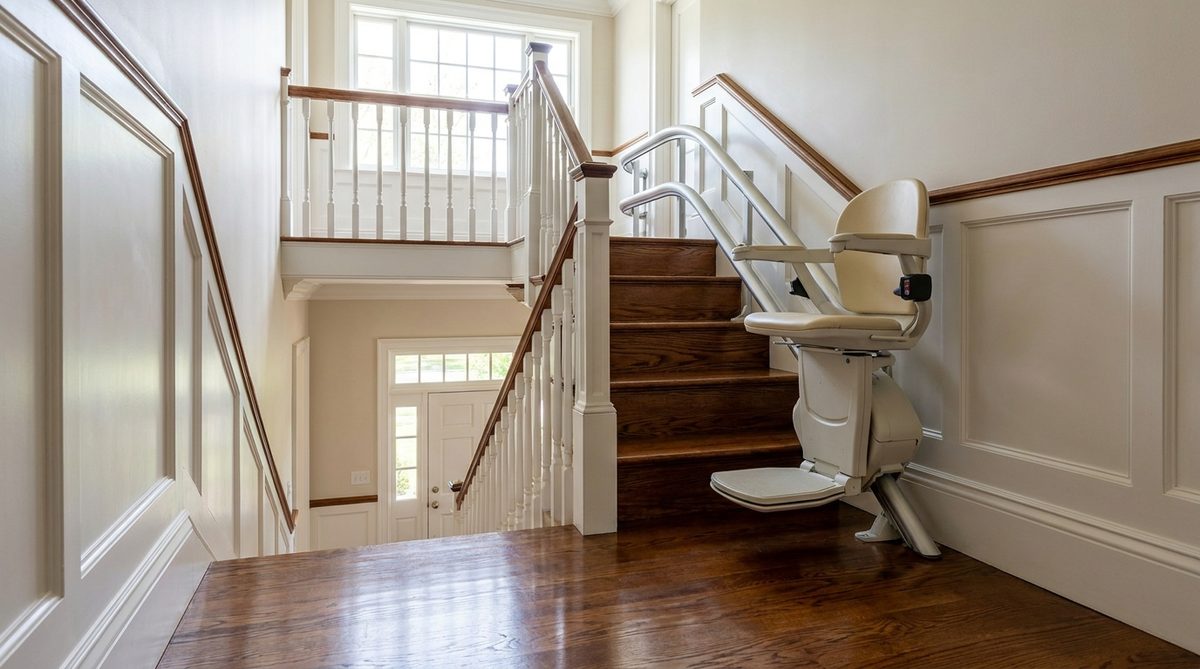
For two-story homes where the bedroom or primary living space is on the second floor, a stairlift can be the difference between staying home and moving. Straight stairlifts cost $2,500–$5,000 installed. Curved stairlifts — required for L-shaped or spiral staircases — run $8,000–$15,000 because the rail must be custom-manufactured.
I always advise clients to look into certified pre-owned stairlifts as well. Companies like Stannah and Acorn offer refurbished units at 30–40% discounts with full warranties. A straight refurbished stairlift can come in under $2,000.
4. Ramps and Zero-Step Entries
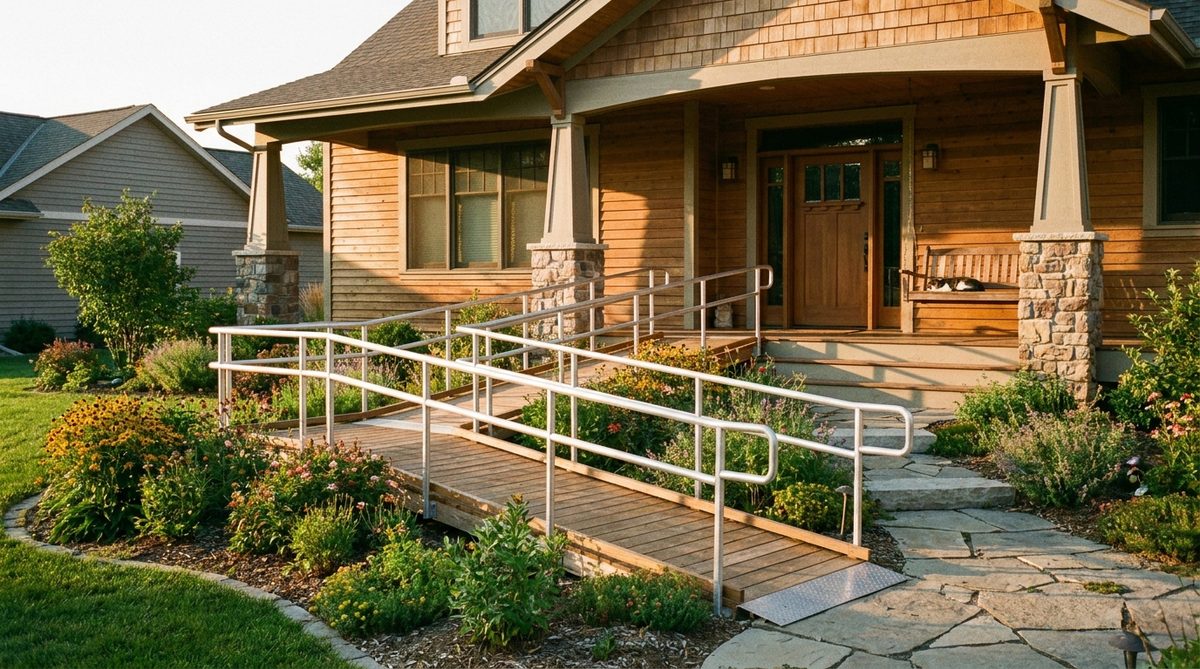
The ADA recommends a 1:12 slope ratio for wheelchair ramps — meaning one inch of rise requires 12 inches of ramp length. For a home with a 24-inch-high front entry, that’s a 24-foot ramp. Permanent wooden ramps cost $1,000–$3,500. Aluminum modular ramps range from $1,500–$8,000 depending on length and configuration, but they’re faster to install and can be relocated.
Even if you don’t use a wheelchair now, a zero-step entry benefits anyone with knee pain, balance issues, or who simply carries groceries. I’ve seen a growing trend of homeowners in their early 50s adding gentle ramps during porch renovations — proactive planning that pays dividends for decades.
5. Lighting and Smart Home Upgrades
This category is often overlooked in aging-in-place conversations, and I think that’s a mistake. The National Institute on Aging emphasizes that poor lighting is a significant contributor to falls among older adults. By age 60, the average person needs three times more light than a 20-year-old to see the same detail.
Motion-activated LED lighting for hallways, stairs, and bathrooms costs $50–$150 per fixture, and a full-home lighting upgrade runs $500–$2,000. Smart home additions like voice-activated light controls (Amazon Echo, Google Nest), smart locks, and video doorbells add another $300–$1,000 but deliver both safety and convenience benefits.
Cost Comparison: Modifications vs. Assisted Living vs. Nursing Care
| Option | Upfront/Annual Cost | 5-Year Total Cost | Independence Level |
|---|---|---|---|
| 5 Core Home Modifications | $8,000–$19,000 (one-time) | $8,000–$19,000 | Full independence in own home |
| In-Home Aide (20 hrs/week) | $28,000–$34,000/year | $140,000–$170,000 | High independence with support |
| Assisted Living Facility | $64,200/year (median) | $321,000 | Moderate independence |
| Nursing Home (Private Room) | $116,800/year (median) | $584,000 | Limited independence |
The five-year math is staggering. Even if you invest $19,000 in modifications and later add a part-time home aide, you’re still spending a fraction of what assisted living costs. And you’re sleeping in your own bed, in your own neighborhood, with your own routines intact.
Of course, these numbers hit differently depending on your retirement income. If you’re curious about what’s actually landing in retirees’ bank accounts, What Retirees Actually Take Home After Medicare in 2026 provides the real after-deduction picture.
How to Pay for Home Modifications Without Depleting Savings
Cost is the number one reason homeowners delay aging-in-place modifications. But there are more funding options available than most people realize. Here are the primary sources I help clients navigate:
Medicaid Home and Community-Based Services (HCBS) Waivers
Forty-seven states now offer Medicaid HCBS waivers that can cover home modifications for qualifying low-income seniors. Coverage varies dramatically by state — some cover up to $10,000 in modifications, others cap at $3,000. Eligibility typically requires meeting income thresholds and demonstrating that modifications will prevent or delay institutional care.
Veterans Affairs (VA) Programs
Veterans have access to several programs specifically for home accessibility. The Specially Adapted Housing (SAH) grant provides up to $109,986 (2025 figure) for veterans with service-connected disabilities. The Home Improvements and Structural Alterations (HISA) grant provides up to $6,800 for service-connected conditions and $2,000 for non-service-connected conditions.
Area Agency on Aging (AAA) Grants
Your local Area Agency on Aging may offer small grants — typically $1,500–$5,000 — for critical home modifications. These are funded through the Older Americans Act and are income-based. Contact your local AAA through the Eldercare Locator (1-800-677-1116) to check availability in your county.
Additional Funding Sources
- USDA Rural Development Loans and Grants: Available for rural homeowners aged 62+ with incomes below 50% of area median. Grants up to $10,000; loans up to $40,000 at 1% interest.
- Rebuilding Together: A national nonprofit that provides free home modifications to low-income seniors, veterans, and people with disabilities. Over 100 local affiliates nationwide.
- Home equity options: HELOCs and reverse mortgages (HECMs) can fund modifications, though I always recommend consulting a HUD-approved housing counselor before pursuing a reverse mortgage.
- Tax deductions: If modifications are medically necessary (documented by a physician), they may qualify as deductible medical expenses on Schedule A — the portion exceeding 7.5% of adjusted gross income.
The Modifications Most People Forget — And Shouldn’t
Beyond the five core modifications, there’s a second tier of upgrades that I find dramatically improve daily life for older adults. These aren’t always covered in standard aging-in-place checklists, but they come up constantly in my assessments.
Lever-Style Door Handles and Faucets
Round doorknobs require grip strength and wrist rotation that becomes increasingly difficult with arthritis. Swapping every knob in a home to lever-style handles costs $15–$40 per handle and takes about 15 minutes each. For a typical three-bedroom home, that’s a $200–$500 project that makes every room accessible.
Raised Toilet Seats
Standard toilets are 15 inches high. “Comfort height” or ADA-compliant toilets measure 17–19 inches. For someone with knee or hip problems, those extra two to four inches can mean the difference between independent toileting and needing assistance. A bolt-on raised seat costs $30–$80. Replacing the entire toilet with a comfort-height model runs $250–$600 installed.
Non-Slip Flooring
Glossy tile, polished hardwood, and even certain laminates become hazardous when wet or when socks are worn. Textured vinyl plank flooring — which has exploded in quality over the past five years — offers excellent slip resistance, is waterproof, and costs $3–$7 per square foot installed. For a hallway, kitchen, and bathroom, a full flooring upgrade runs $2,000–$5,000.
Kitchen Accessibility
Pull-out shelving in lower cabinets ($100–$300 per cabinet), D-shaped cabinet pulls ($5–$15 each), and adjustable-height countertop sections ($1,500–$4,000) transform kitchens from obstacle courses into functional spaces. I especially recommend pull-out cutting boards and lazy Susans in corner cabinets — small changes that reduce reaching and bending.
When to Start: The Case for Proactive Modification
The biggest misconception I encounter is that home modifications are something you do after a fall or a diagnosis. By then, you’re often making decisions under pressure — in a hospital, during rehabilitation, or while a family member scrambles to arrange accommodations before discharge. That’s not when you want to be comparing contractors and applying for grants.
The ideal time to begin planning aging-in-place modifications is between ages 55 and 65 — before urgency dictates choices. At that stage, you can:
- Spread costs over several years of budgeting
- Incorporate modifications into planned renovations (saving on labor)
- Choose materials and designs you actually like, rather than settling for whatever’s available immediately
- Apply for grants and programs without the time pressure of a medical crisis
I call this “renovation with intention.” When a client is already planning a bathroom remodel, adding grab bar blocking behind the walls costs almost nothing — $50–$100 in lumber. But retrofitting grab bars after the walls are tiled? That’s $200–$300 per bar because you’re working with existing structure.
Staying physically active is another critical part of the equation, and it’s one that works hand-in-hand with a safe home environment. As outlined in Why Elderly Patients in the Hospital Need to Keep Moving, maintaining mobility isn’t just about exercise — it’s about having a home that supports and encourages movement.
How to Find a Qualified Aging-in-Place Contractor
Not every contractor understands aging-in-place requirements. A grab bar installed into drywall without proper blocking can pull out under load — I’ve seen it happen, and the consequences were serious. Here’s how to find someone qualified:
- CAPS Certification: Look for contractors with the Certified Aging-in-Place Specialist designation from the National Association of Home Builders. There are roughly 4,500 active CAPS professionals in the U.S.
- Occupational Therapist Collaboration: The best outcomes I’ve seen involve an OT conducting a home assessment first, then working with a CAPS contractor to implement recommendations. Many Medicare Advantage plans cover OT home assessments.
- References Specific to Aging-in-Place Work: Ask for references from clients over 65. General remodeling experience doesn’t automatically translate to understanding accessibility needs.
- ADA Knowledge: Your contractor should know ADA guidelines even for residential work — proper grab bar placement heights (33–36 inches for horizontal bars), ramp slope ratios, and doorway clearance minimums (32 inches clear).
The Emotional Side of Modification — And Why It Matters
I’d be doing a disservice if I only discussed the financial and physical dimensions. There’s an emotional component to home modifications that doesn’t get enough attention.
For many of my clients, the suggestion that their home needs to change feels like an admission of decline. I understand that. Your home is a reflection of your identity, your history, your taste. Adding a grab bar next to the toilet doesn’t exactly feel like a design upgrade.
But here’s what I’ve witnessed over 14 years: the clients who modify their homes proactively feel empowered. They’re making a decision. They’re investing in their future on their own terms. The clients who modify reactively — after a fall, after a scare — often feel diminished. The modification reminds them of the event.
The difference isn’t in the grab bar. It’s in the timing and the framing. When you choose to make your home safer, you’re choosing independence. When the choice is made for you, it feels like something was taken away.
Modern accessibility products have also come a long way aesthetically. Companies like Moen (Home Care line), Delta (Grab Bar Collection), and specialty brands like HealthCraft offer products that look like they belong in a luxury bathroom, not a clinical setting. Brushed nickel, matte black, oil-rubbed bronze — these aren’t your grandmother’s institutional chrome bars.
The Bottom Line: Investing in Your Home Is Investing in Your Freedom
The data is clear. Home modifications for aging in place are among the highest-return investments a homeowner over 50 can make — not in terms of property value (though they can help there too), but in terms of preserved independence, avoided medical costs, and quality of life.
For less than the cost of three months in an assisted living facility, you can make your home safe enough to live in for another decade or more. You can shower without fear, navigate stairs without risk, and enter your own front door without negotiating a step that’s become an obstacle.
If you take one thing from this analysis, let it be this: don’t wait for the fall. Don’t wait for the diagnosis. Walk through your home this week with fresh eyes — or better yet, with a CAPS professional — and identify the three modifications that would make the biggest difference. Start with the grab bars. They cost less than dinner for two at a nice restaurant, and they might save your life.
About Marcus Bell, Certified Aging-in-Place Specialist (CAPS)
Marcus Bell is a Certified Aging-in-Place Specialist (CAPS) with 14 years of experience helping American seniors create safer, more comfortable living environments. He has consulted on hundreds of home modifications — from bathroom safety upgrades to smart home installations — and writes extensively about the products, services, and strategies that help older adults live independently for longer. At Daily Trends Now, Marcus covers home improvement, aging-in-place solutions, gardening, and practical lifestyle tips for seniors.