

The Surprising Statistic That Should Change How You Think About Aging in Place
Here’s a number that stopped me cold when I first encountered it: according to the National Council on Aging, one in four Americans aged 65 and older falls every year—yet fewer than half of them ever tell their doctor. Falls are the leading cause of injury-related death among adults over 65, claiming over 38,000 lives annually. And the majority of those falls happen inside the home.
Now contrast that with this: a 2024 AARP survey found that 77% of adults over 50 want to remain in their current home as they age. That gap—between the desire to stay put and the structural readiness of the average American home—is something I confront in my work every single week.
In my 14 years as a Certified Aging-in-Place Specialist, I’ve walked through well over a thousand homes. What I see most often is a troubling disconnect. Homeowners invest in cosmetic upgrades—new countertops, fresh paint, trendy fixtures—while ignoring the modifications that could literally save their lives. This deep-dive analysis examines which aging-in-place modifications deliver real, measurable safety and well-being benefits, which ones waste money, and how to prioritize when budgets are tight.
What the Research Actually Shows About Home Modifications
A landmark 2024 empirical study published in the journal BMC Public Health examined the impact of age-friendly home modifications on the well-being of older adults across multiple dimensions: physical safety, psychological comfort, and social engagement. The findings were striking. Participants who received targeted, evidence-based modifications reported a 40% reduction in fall-related injuries and significantly higher scores on standardized well-being assessments compared to control groups.
But here’s what most articles on this topic miss: not all modifications are created equal. The study revealed that a small cluster of changes accounted for the overwhelming majority of safety improvements. Meanwhile, several commonly recommended modifications showed negligible impact when implemented in isolation.
This mirrors what I’ve observed in practice. I often tell my clients that aging in place isn’t about checking every box on a generic home-safety checklist. It’s about understanding your specific risk profile and addressing the highest-impact vulnerabilities first.
The “Big Three” Modifications With the Strongest Evidence
After reviewing the available research and cross-referencing it with outcomes I’ve tracked across my own client base, three categories of modification consistently rise to the top:
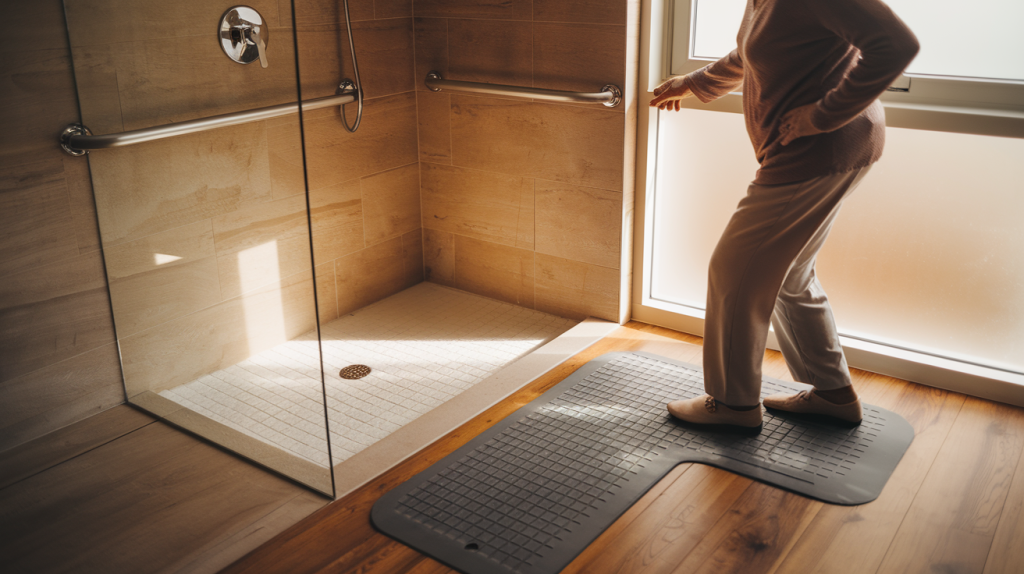
- Bathroom grab bars and non-slip surfaces: The CDC reports that 80% of fall-related injuries in the home occur in the bathroom. Properly anchored grab bars near the toilet and inside the shower/tub area reduce fall risk by an estimated 30-40%. Non-slip flooring and shower mats add another protective layer. Total cost: typically $200-$600 for professional installation.
- Improved lighting throughout the home: Age-related vision changes—reduced contrast sensitivity, slower dark adaptation—make poorly lit hallways, staircases, and entryways treacherous. Motion-activated LED lighting in key transition zones is one of the most cost-effective safety upgrades I recommend, often under $150 for an entire home.
- Elimination of trip hazards and threshold modifications: Raised thresholds between rooms, loose rugs, and cluttered pathways are involved in roughly 30% of in-home falls among older adults. Flush transitions, secured rugs (or their removal), and clear pathways cost almost nothing but deliver outsized safety benefits.
What connects all three? They’re relatively inexpensive, they address statistically validated risk factors, and they don’t require major renovation. If you’re over 50 and haven’t addressed these three areas, they should be your starting point—period.
The Modifications That Get Overhyped—and When They Actually Make Sense
I want to be honest about something that might be unpopular in my industry: not every aging-in-place modification is worth the investment for every homeowner. Some of the most expensive upgrades get recommended prematurely, and that can drain retirement savings without delivering proportional safety benefits. If you’re concerned about retirement savings depleting faster than expected, strategic prioritization matters enormously.
Stairlifts: $3,000-$15,000
Stairlifts are a classic example. They’re genuinely life-changing for someone with significant mobility limitations or a condition like advanced COPD. But I’ve seen them sold to 62-year-olds with mild knee stiffness who would have been far better served by handrail upgrades on both sides of the staircase ($300-$800) and a lower-body strength-training routine.
My rule of thumb: if you can still safely navigate stairs with proper handrails, invest in maintaining your strength and balance first. A stairlift should be a solution for a confirmed, persistent need—not a preemptive purchase driven by fear.
Full Bathroom Remodels With Walk-In Tubs: $8,000-$20,000+
Walk-in tubs get marketed aggressively to the 50-plus demographic. They do serve a purpose for individuals with severe mobility challenges. But the data on their fall-prevention effectiveness is surprisingly thin compared to the far simpler grab-bar-and-non-slip combination. Walk-in tubs also introduce new risks: the user must sit inside while the tub fills and drains, which means prolonged exposure to cold and a period of immobility. A curbless shower with a built-in bench, grab bars, and a handheld showerhead often provides superior safety at a lower cost.
Whole-Home Smart Systems: $2,000-$10,000+
Smart-home technology can be a powerful tool for aging in place, but I see too many people investing in comprehensive systems they don’t fully understand or use. A medical alert pendant, a smart doorbell, and motion-sensor lighting cover 80% of what most older adults actually need from technology. For a focused look at the devices that genuinely make a difference, I recommend reading about the tech devices that make aging in place safer in 2026.
A Room-by-Room Priority Framework
Rather than handing out a one-size-fits-all checklist, I walk clients through a priority-based framework. The goal is to address the highest-risk zones first and expand from there based on individual health trajectory and budget.
Priority 1: The Bathroom
This is always where I start, and the data supports it unequivocally. The National Council on Aging identifies bathroom falls as the single most common cause of emergency-room visits among adults over 65 living independently.
- Install grab bars at the toilet (one vertical, one horizontal) and inside the shower area (minimum two bars).
- Replace smooth flooring with textured, non-slip material or apply adhesive non-slip strips.
- Add a handheld showerhead on an adjustable slide bar.
- Ensure adequate lighting—a minimum of 50 foot-candles at the shower entry, per accessibility guidelines.
- Consider a comfort-height toilet (17-19 inches) if current fixtures are standard height (15 inches).
Estimated total for a comprehensive bathroom safety upgrade without a full remodel: $400-$1,200.
Priority 2: Hallways, Staircases, and Transitions
These are the in-between spaces where people move without thinking—and where inattention meets poor design. I’ve investigated falls that happened on a single step between a kitchen and a sunken living room, trips over a rug edge in a dimly lit hallway, and stumbles on stairs with only one handrail.
- Install handrails on both sides of every staircase, extending beyond the top and bottom steps.
- Add motion-activated lighting at the top and bottom of stairs and along hallways.
- Eliminate or permanently secure all area rugs with double-sided carpet tape rated for the specific flooring type.
- Apply contrasting tape to stair edges if treads are uniform in color.
Estimated total: $200-$800.
Priority 3: The Kitchen
The kitchen is where older adults spend significant daily time, and it presents both fall and burn risks. Reaching for high shelves is a common injury trigger.
- Move frequently used items to waist-to-shoulder height—eliminate the need for step stools.
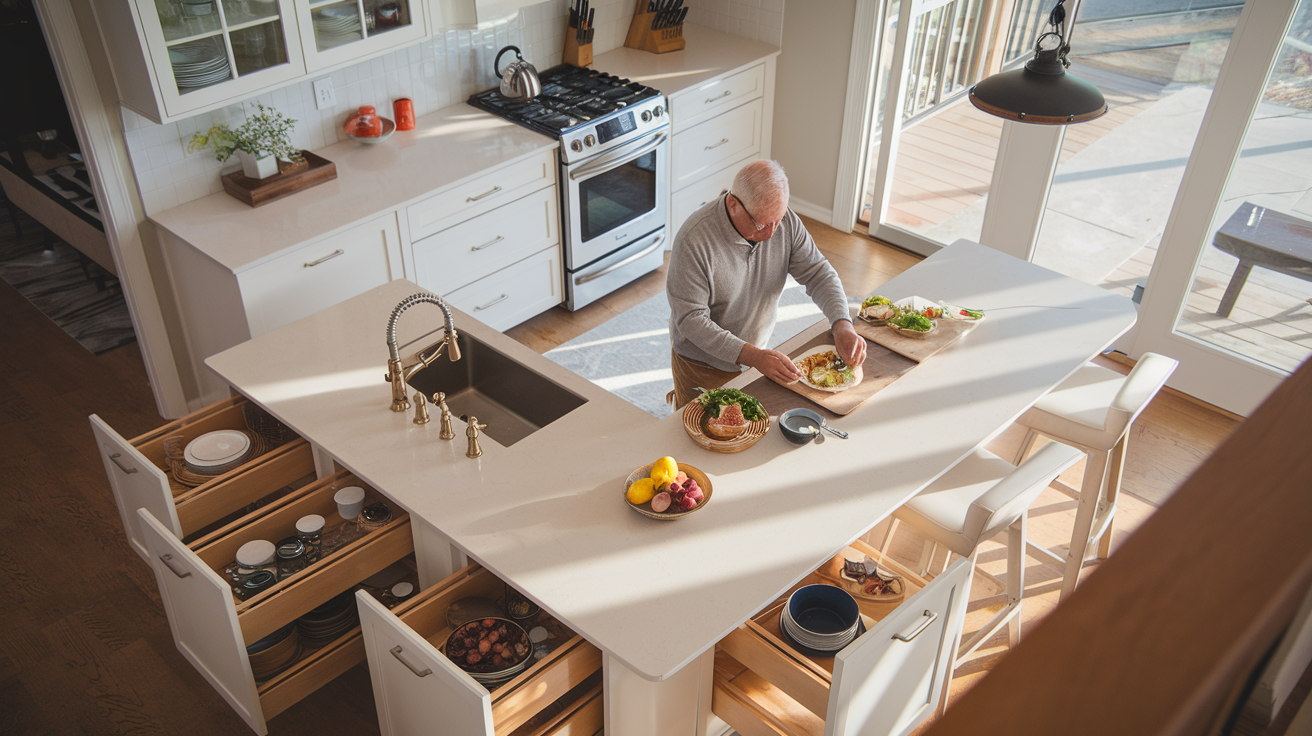
- Install pull-out shelving in lower cabinets to reduce bending and reaching.
- Replace round knobs with lever-style or D-pull handles on cabinets and faucets.
- Add under-cabinet LED task lighting to improve visibility on countertops.
- Consider an induction cooktop if you’re still using gas or traditional electric—induction surfaces don’t produce open flame and cool rapidly, reducing burn risk by an estimated 60%.
Estimated total: $300-$2,500, depending on whether cabinetry modifications are needed.
Priority 4: Entries and Exterior
The transition from outdoors to indoors is a high-risk zone that’s often overlooked. According to AARP, roughly 20% of falls among older adults happen at exterior entry points.
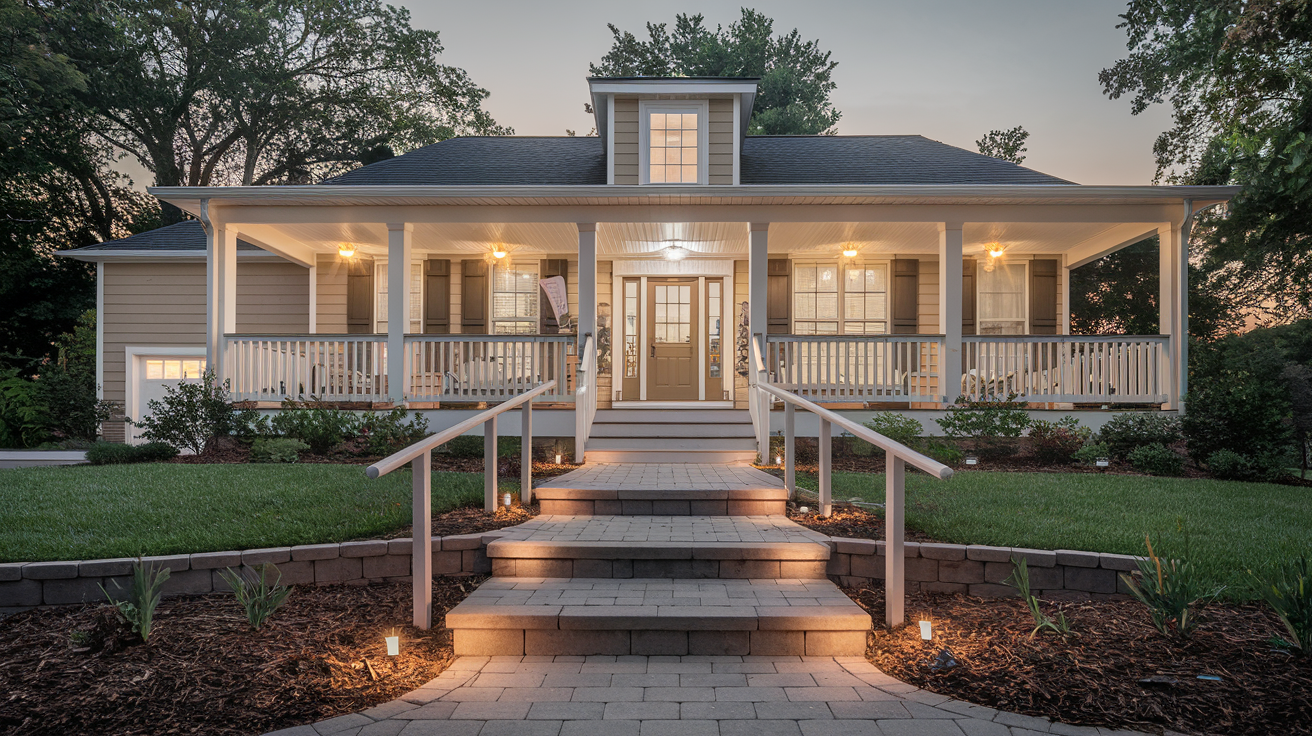
- Create a zero-step entry at the primary entrance—a gently sloped pathway or ramp that eliminates the need to navigate steps while carrying groceries, managing a walker, or dealing with rain.
- Install adequate exterior lighting with dusk-to-dawn sensors.
- Ensure walkways are even, free of cracks, and treated for slip resistance in wet conditions.
- Add a sturdy bench or shelf near the front door for setting down bags while unlocking.
Estimated total: $500-$5,000, with the wide range depending on whether ramp construction is needed.
The Hidden Variable: Your Body Is a Modification, Too
I can’t write honestly about aging in place without addressing something that falls outside the traditional scope of home modification: physical fitness. The research is unambiguous. A 2023 meta-analysis in the British Medical Journal found that exercise programs focused on balance and lower-body strength reduce fall rates among older adults by 23%. When combined with home modifications, the reduction reaches approximately 38%.
Your body is the most important “structure” in your aging-in-place plan. Grab bars and non-slip surfaces catch you when your balance fails. But strength, flexibility, and proprioception training reduce how often your balance fails in the first place. If you’re building a comprehensive approach to healthy aging, combining home modifications with the healthy aging habits that protect your body after 50 is the highest-impact strategy I know.
How Much Does Aging in Place Really Cost Versus the Alternatives?
Let’s talk numbers, because this is where the aging-in-place conversation gets genuinely compelling. The Genworth Cost of Care Survey (2024) reports the following median annual costs for long-term care in the United States:
- Assisted living facility: $64,200 per year
- Nursing home (semi-private room): $104,025 per year
- Home health aide (44 hours/week): $75,504 per year
Compare those figures to the comprehensive home-modification budget I’ve outlined above. Even a thorough, professionally guided aging-in-place renovation addressing all four priority zones typically runs between $1,500 and $10,000—a one-time investment that often extends independent living by years.
The financial case is overwhelmingly clear. Every year you delay or avoid institutional care through smart home modifications and proactive health management represents tens of thousands of dollars preserved. For context on protecting those savings more broadly, understanding how to shield retirement savings from inflation is equally essential.
When to Call a Professional—and What Credentials to Look For
Many basic modifications—securing rugs, improving lighting, reorganizing kitchen shelves—are straightforward DIY projects. But certain work requires professional expertise, and I want to be specific about when and why.
You should hire a professional for any modification that involves structural attachment (grab bars must be anchored to wall studs or blocking, not just drywall), electrical work (hardwired lighting, outlet additions), or construction (ramps, curbless showers, widened doorways).
When hiring, look for these credentials:
- CAPS (Certified Aging-in-Place Specialist): Offered through the National Association of Home Builders, this designation requires specific training in designing and building aging-friendly home modifications.
- OTR/L (Registered Occupational Therapist): An occupational therapist can conduct a formal home safety assessment tailored to your specific physical abilities and health conditions. Many insurance plans cover this.
- Licensed contractor with ADA experience: For larger projects, ensure your contractor has verifiable experience with accessibility construction and can provide references from similar projects.
I recommend starting with an occupational therapy home assessment. It typically costs $150-$350 out of pocket (often covered by Medicare Part B with a physician’s referral) and produces a prioritized, personalized list of recommended modifications. This prevents the scattershot approach that wastes money on low-impact changes.
The Bottom Line: Strategy Over Spending
After 14 years in this field, the most important thing I can tell you is this: aging in place successfully is not about spending the most money. It’s about spending strategically, starting early, and recognizing that your home is a dynamic environment that should evolve alongside your body.
The homeowners who fare best are the ones who make bathroom safety upgrades in their mid-50s—before a fall forces the issue. They improve lighting before vision changes cause a stumble. They install that second handrail when it’s a convenience, not a desperation.
The data shows these modifications work. The economics prove they’re worth it. And in my experience, the peace of mind they provide—for you and for the people who love you—is something no price tag can capture. As emerging research continues to affirm, aging doesn’t have to mean decline. But it does require preparation. Start with your bathroom. Improve your lighting. Clear your pathways. Build from there.
Your home has sheltered you for decades. With the right modifications, it can keep doing that job for decades more.
Frequently Asked Questions
What is the most important aging-in-place modification I should make first?
Bathroom safety upgrades—specifically grab bars near the toilet and inside the shower, along with non-slip flooring—should be your first priority. The CDC reports that 80% of in-home fall injuries among older adults occur in the bathroom, making this the highest-impact modification you can make, often for under $600.
How much does it cost to modify a home for aging in place?
A comprehensive set of evidence-based modifications covering the bathroom, hallways, kitchen, and entryway typically costs between $1,500 and $10,000, depending on the scope of work. This is a one-time investment compared to assisted living costs that average $64,200 per year, making it one of the smartest financial decisions retirees can make.
Does Medicare pay for aging-in-place home modifications?
Medicare does not directly cover most home modifications like grab bars or ramp construction. However, Medicare Part B often covers an occupational therapy home safety assessment when ordered by a physician, which gives you a professional, prioritized plan. Some Medicare Advantage plans and state Medicaid waiver programs do offer home modification benefits, so check your specific coverage.
At what age should I start making aging-in-place modifications?
The ideal time to begin is in your mid-50s, before a fall or health event forces urgent, reactive changes. Starting early allows you to spread costs over time, make modifications when they're convenient rather than critical, and build habits around a safer living environment. Many CAPS professionals recommend treating your 55th birthday as a prompt for a baseline home safety evaluation.
About Marcus Bell, Certified Aging-in-Place Specialist (CAPS)
Marcus Bell is a Certified Aging-in-Place Specialist (CAPS) with 14 years of experience helping American seniors create safer, more comfortable living environments. He has consulted on hundreds of home modifications — from bathroom safety upgrades to smart home installations — and writes extensively about the products, services, and strategies that help older adults live independently for longer. At Daily Trends Now, Marcus covers home improvement, aging-in-place solutions, gardening, and practical lifestyle tips for seniors.