


The COLA Reality Check Most Retirees Need Right Now
Every October, I watch millions of retirees hold their breath waiting for the Social Security cost-of-living adjustment announcement. And every January, when the new amount hits their bank accounts, I hear the same frustrated refrain from clients: “That’s it?”
In my 20 years as a CPA and Enrolled Agent working with retirees, I’ve seen how deeply misunderstood the Social Security COLA really is. The 2026 adjustment of 2.8% sounded reasonable on paper. But the early forecasts for the 2027 Social Security COLA — currently projected around 2.2% to 2.5% by the Senior Citizens League — tell a story that’s even more concerning when you strip away the myths.
The problem isn’t just the size of the adjustment. It’s that most retirees are operating under a set of beliefs about COLA that are flat-out wrong — and those misconceptions are quietly draining their retirement savings. Let me walk you through the six biggest ones.
Myth #1: The COLA Is Designed to Keep Retirees Even With Inflation
The Truth: It Tracks a Basket of Goods That Doesn’t Reflect Senior Spending
This is the foundational myth, and it shapes all the others. The Social Security COLA is calculated using the Consumer Price Index for Urban Wage Earners and Clerical Workers, known as CPI-W. Read that again: urban wage earners and clerical workers. Not retirees.
The CPI-W heavily weights costs like commuting, workplace clothing, and education — expenses that matter far less to a 72-year-old than to a 35-year-old office worker. Meanwhile, the categories where seniors spend disproportionately more — healthcare, housing maintenance, and prescription drugs — are underweighted in the formula.
The Bureau of Labor Statistics does publish an experimental index called the CPI-E (for elderly), which consistently shows inflation running 0.2% to 0.3% higher annually for Americans 62 and older. Over a 20-year retirement, that gap compounds into thousands of dollars in lost purchasing power. According to the Social Security Administration, the average retired worker receives about $1,976 per month in 2026. A persistent 0.3% annual shortfall doesn’t sound dramatic until you calculate the cumulative loss over a decade: roughly $3,500 to $4,800 depending on benefit level.
I often tell my clients that the COLA isn’t broken — it’s just not built for them. That’s a critical distinction, because it means you can’t rely on it as your sole inflation defense.
Myth #2: A Bigger COLA Always Means More Money in Your Pocket
The Truth: Medicare Part B Premiums Absorb Much of the Increase
This is the myth that causes the most sticker shock every January. In 2026, the 2.8% COLA translated to roughly $50 more per month for the average beneficiary. But the standard Medicare Part B premium rose to $185 per month — an increase of $10.30 from the previous year. For many retirees, that single adjustment consumed about a third of their raise before they bought a single grocery item.
What I see most often is clients forgetting that Part B premiums are deducted directly from Social Security payments. So the number that shows up in your bank account reflects the net — not the gross — increase. And for higher-income retirees subject to IRMAA (Income-Related Monthly Adjustment Amount) surcharges, the Medicare bite can swallow the entire COLA and then some.
As I’ve detailed in a previous analysis, Social Security’s 2.8% COLA is already failing many retirees in 2026. The 2027 projection of a potentially even smaller adjustment makes this math worse, not better.
Myth #3: If Inflation Cools Down, Retirees Are in the Clear
The Truth: Prices Don’t Go Back Down — They Just Rise More Slowly
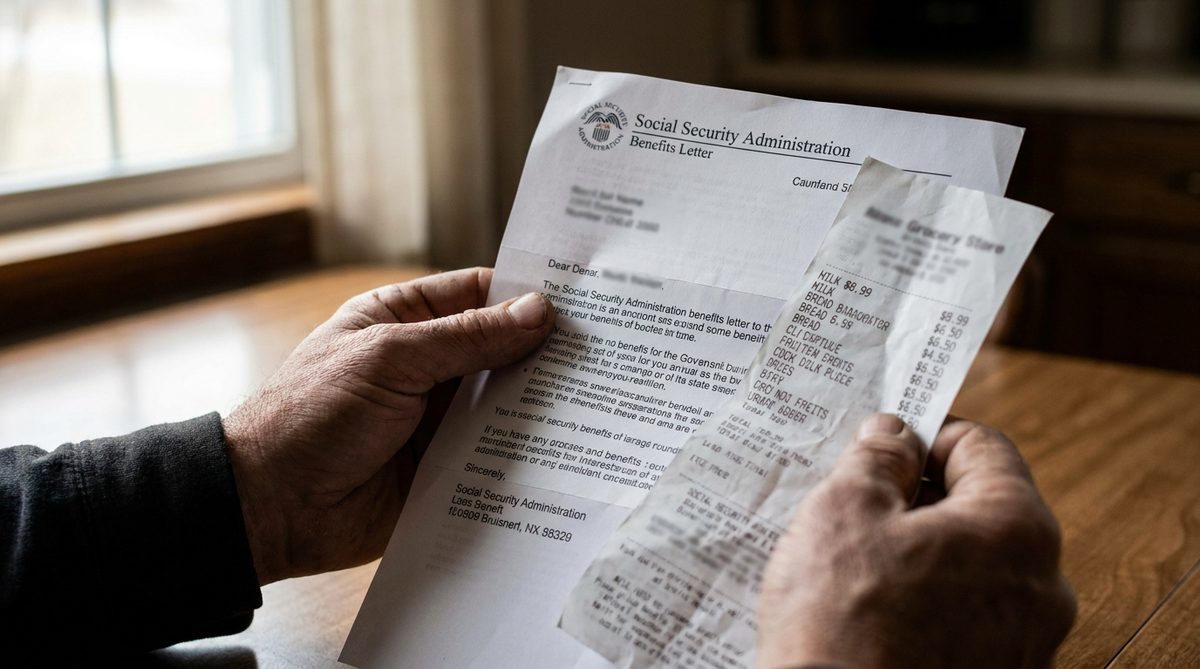
This is perhaps the most dangerous misconception I encounter. When clients hear that inflation is “falling,” many assume their costs are decreasing. They’re not. A lower inflation rate means prices are still climbing — just at a slower pace than before.
Consider this: between January 2021 and the end of 2025, cumulative inflation exceeded 22% as measured by CPI. The COLAs during that same period — 1.3%, 5.9%, 8.7%, 3.2%, and 2.5% — totaled roughly 21.6% on a compounded basis. That looks close on paper, but remember Myth #1: the index used doesn’t reflect senior-specific spending. For retirees, the real-world cumulative inflation gap is wider.
Grocery prices rose over 25% during that stretch. Medicare costs outpaced general inflation. Home insurance premiums surged 30% or more in many states. These are not abstract numbers — they’re the bills sitting on your kitchen counter. A cooling CPI-W doesn’t undo the damage already baked into your monthly expenses.
Recent survey data confirms what I’m seeing in my practice: retirees are depleting savings faster than planned, with many drawing down principal years earlier than their retirement projections anticipated.
Myth #4: You Can’t Do Anything About the COLA — It Is What It Is
The Truth: Strategic Tax and Income Planning Can Offset COLA Shortfalls
Accepting a shrinking COLA as inevitable is financially dangerous. While you can’t change the formula, you absolutely can change how efficiently you manage the income you have. Here are strategies I regularly implement with my clients:
- Roth conversion laddering: Converting small portions of traditional IRA funds to Roth accounts in lower-income years can reduce future Required Minimum Distributions (RMDs) and keep you below IRMAA thresholds — preserving more of your COLA.
- Tax bracket management: Many retirees don’t realize that up to 85% of Social Security benefits become taxable above certain combined income thresholds ($34,000 for single filers, $44,000 for married filing jointly). Careful withdrawal sequencing from taxable, tax-deferred, and tax-free accounts can keep more money in your pocket.
- IRMAA appeals: If your income spiked in a prior year due to a one-time event — selling a home, taking a large RMD, or realizing capital gains — you can file SSA Form SSA-44 to request a reduction in your Medicare premium surcharge. I’ve helped dozens of clients save $1,000 to $4,000 annually with this single form.
- Qualified Charitable Distributions (QCDs): If you’re 70½ or older and charitably inclined, directing up to $105,000 per year (2025 limit, indexed for inflation) from your IRA directly to charity satisfies your RMD without increasing your adjusted gross income. This can prevent IRMAA triggers and keep Social Security taxation lower.
The IRS provides detailed guidance on QCDs and RMD rules that every retiree — or their tax professional — should review annually. These aren’t exotic strategies; they’re standard tools that too few retirees use.
Myth #5: The Maximum Social Security Benefit Means You’re Set for Life
The Truth: Even the Highest Earners Face Purchasing Power Erosion
Headlines this week announced that Social Security payments of up to $5,181 per month are arriving for certain beneficiaries. That figure — the maximum benefit for someone who delayed claiming until age 70 in 2025 — sounds impressive. But it creates a false sense of security.
First, very few retirees actually receive the maximum. You’d need to have earned at or above the taxable maximum (currently $176,100) for at least 35 years and delayed benefits until 70. According to SSA data, the average retired worker benefit is less than $2,000 per month — roughly 38% of the theoretical maximum.
Second, even at $5,181 per month, the same COLA erosion applies. A 2.8% raise on $5,181 is about $145 per month before Medicare deductions. After Part B premiums and potential IRMAA surcharges for high earners, the net increase shrinks considerably. High-income retirees in IRMAA Tier 2 or above can pay Part B premiums exceeding $500 per month — meaning their COLA may effectively disappear.
The broader changes to Medicare in 2026, including the new $2,000 annual cap on Part D out-of-pocket drug costs under the Inflation Reduction Act, do provide some relief. But as I’ve explained in a deeper analysis, Social Security and Medicare shifts are fundamentally reshaping retiree budgets this year in ways that require active planning, not passive acceptance.

Myth #6: The 2027 COLA Forecast Doesn’t Affect You Yet
The Truth: The Planning Window Is Right Now
The most recent projections from the Senior Citizens League and Investopedia’s analysis suggest the 2027 Social Security COLA could land between 2.2% and 2.5%, potentially the smallest adjustment since 2021’s 1.3%. Some forecasters note the “good news” — inflation is moderating. But the bad news is equally clear: a smaller COLA on top of an already-eroded base means the purchasing power gap widens further.
What concerns me most in my practice is the number of retirees who treat COLA projections as tomorrow’s problem. The decisions you make this year — Roth conversions, RMD timing, Medicare plan selections during open enrollment, and withdrawal strategies — directly determine how much of next year’s COLA you actually keep.
For example, if you’re approaching one of the IRMAA income thresholds in 2026, accelerating or deferring certain income now could save you hundreds of dollars per month in Medicare premiums in 2027. These thresholds are based on your tax return from two years prior, which means your 2025 income (filed in 2026) determines your 2027 Medicare costs.
What Smart Retirees Are Doing Differently
The retirees I work with who navigate COLA shortfalls most successfully share a few common habits. They review their Social Security and Medicare statements every year — not just when the COLA is announced. They work with a tax professional who understands the interplay between Social Security taxation, IRMAA brackets, and withdrawal sequencing. And they don’t treat their COLA as found money — they budget the net increase, not the gross.
Some are also supplementing their income in creative ways. I’ve seen retired clients turn woodworking, consulting, and even tutoring into meaningful income streams. If that resonates, there’s a great resource on creative ways retirees turn hobbies into steady cash that’s worth exploring.
Above all, the retirees who fare best reject the passive mindset that the system will take care of them. The COLA was never designed to be a full inflation shield for seniors. Understanding that reality — not the myth — is the first step toward protecting the retirement you’ve worked your entire life to build.
The Bottom Line: Stop Believing the COLA Will Save You
The Social Security COLA is one tool in a much larger toolkit. It was created as a partial adjustment, calculated using a formula that doesn’t prioritize senior expenses, and it’s consistently offset by rising Medicare premiums and tax bracket interactions. The 2027 forecast only reinforces what the data has shown for years: retirees who rely solely on COLA adjustments to maintain their standard of living will fall behind.
The encouraging news? Every myth I’ve outlined above has a counterstrategy. Whether it’s Roth conversions, IRMAA appeals, QCDs, or simply understanding how the formula actually works, informed retirees have options. The key is acting on them before the next COLA announcement — not after.
Frequently Asked Questions
What is the projected Social Security COLA for 2027?
Early projections from the Senior Citizens League and other analysts estimate the 2027 Social Security COLA will be between 2.2% and 2.5%, though the official announcement won't come until October 2026 based on third-quarter CPI-W data.
Why doesn't the Social Security COLA keep up with retiree inflation?
The COLA is based on the CPI-W index, which tracks spending by urban wage earners and clerical workers — not retirees. This index underweights healthcare and housing costs that disproportionately affect seniors, resulting in a persistent gap between the adjustment and actual retiree inflation.
Can I appeal my Medicare IRMAA surcharge to keep more of my COLA?
Yes. If your income was unusually high in a prior year due to a life-changing event such as retirement, a home sale, or the death of a spouse, you can file SSA Form SSA-44 to request that Social Security use a more recent year's income to determine your Medicare premium, potentially saving you thousands annually.
How much of my Social Security COLA goes to Medicare Part B premiums?
In 2026, the standard Medicare Part B premium increase consumed roughly one-third of the average retiree's 2.8% COLA. For higher-income retirees subject to IRMAA surcharges, Medicare premiums can absorb the entire COLA increase or even exceed it.
About Robert Thompson, CPA, EA (Enrolled Agent)
Robert Thompson is a Certified Public Accountant and IRS Enrolled Agent with over 20 years of experience specializing in retirement tax planning. He has helped thousands of American retirees navigate the tax implications of Social Security benefits, required minimum distributions, 401(k) and IRA withdrawals, and estate planning. At Daily Trends Now, Robert breaks down complex tax rules into clear, actionable strategies that help seniors keep more of their hard-earned money.